You have likely watched your account equity vanish in a heartbeat, wiped out by a single, jagged wick that kissed your liquidation price before the market reversed in your favor. We have all been there. Most traders treat their liquidation price as a distant, abstract number—a safety net that sits far below their actual trade idea. In reality, that “net” is an algorithmic tripwire, and if you aren’t actively managing the space between your entry and your liquidation threshold, you are essentially flying blind in a high-speed environment.
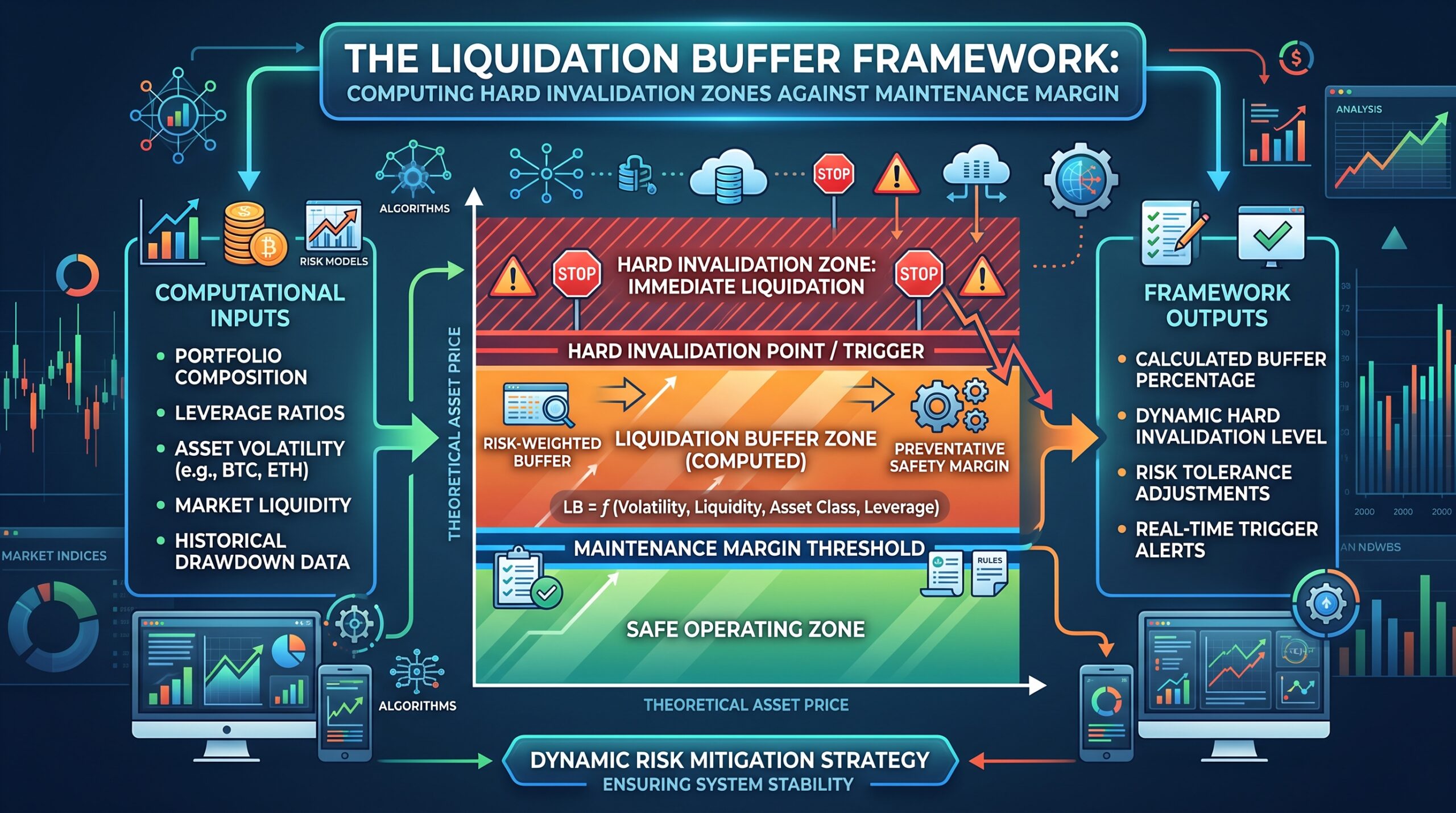
The Liquidation Buffer Framework is your architectural defense against this risk. It is not just about avoiding forced closure; it is about defining your “Hard Invalidation Zone”—the precise price point where your thesis is no longer just wrong, but mathematically untenable. If you want to survive the volatility of crypto futures, you must stop treating liquidation as an afterthought and start managing it as a core component of your strategy.
The Mechanics of the Buffer: Why “Distance” Is Everything
Your liquidation buffer is the percentage distance between the current Mark Price and your liquidation price. When you open a position with high leverage, you are effectively shrinking this buffer, leaving zero room for the natural, messy breathing room of crypto markets. A 5% buffer might feel safe when the market is moving sideways, but in a volatility expansion, that 5% can be liquidated in a single minute.
Expert Insight: I view my liquidation price as a dynamic structural level. If my buffer is less than 10% on a major asset like Bitcoin, I am already over-leveraged for the current volatility regime. A professional doesn’t wait for the exchange to liquidate them; they calculate the “Hard Invalidation Zone” based on their technical analysis and ensure it sits significantly inside their liquidation threshold. If your technical stop-loss is close to your liquidation price, you have already lost the trade.
Computing Your Hard Invalidation Zone
To build this framework, you must align your technical invalidation—the level where your chart pattern breaks—with your account’s maintenance margin requirements. Maintenance margin is the minimum equity you must hold to keep a position open; once your losses eat into this, the exchange initiates a forced exit. Your “Hard Invalidation Zone” is the point where the cost of maintaining the trade exceeds the potential for recovery.
Personal Example: I once held a long position where my chart pattern invalidated at a 4% drop. However, my liquidation price was only 3% away due to the leverage I’d used. Even though I was “technically” right about the bounce, I was liquidated before the bounce occurred because my buffer was too tight. Now, I use a simple rule: my technical stop must always trigger at least 2% above my liquidation price. This ensures I control the exit, rather than the exchange’s engine.
The Funding Rate Variable
Perpetual contracts carry an invisible cost: funding rates. Every 8 hours, these payments either add to your margin or erode it. If you are holding a position in a “crowded” market where funding rates are aggressively high, your liquidation buffer is slowly shrinking every single day you hold the trade.
Expert Insight: Traders often ignore funding until they wake up to find their liquidation price has crept closer to the current price overnight. If you are a swing trader, you must subtract the projected funding costs from your buffer. If the market is moving against you and funding is expensive, your “Hard Invalidation Zone” is moving toward you regardless of what the price does.
Strategies for Buffer Management
Managing your buffer is about proactive, not reactive, adjustment. When the market turns against you, you have three primary levers to widen your buffer:
-
Margin Top-Ups: Adding collateral increases your buffer, but it also increases your total capital at risk. Use this sparingly, only when the technical thesis remains intact.
-
Position Sizing: Reducing your size is the most effective way to push your liquidation price away. It immediately lowers your exposure and widens the “Hard Invalidation Zone.”
-
Leverage Adjustment: If your buffer is too thin, you are over-leveraged. If you find yourself constantly worrying about liquidation, you are trading size that your account equity cannot support.

The Liquidation Buffer Framework is the difference between a trader who survives a flash crash and a trader who becomes the liquidity for the next move. By defining your Hard Invalidation Zone and ensuring it sits well within your maintenance margin, you reclaim control over your exit. Stop gambling on the exchange’s mercy. Calculate your buffer, respect the maintenance requirements, and trade with a structure that keeps your capital alive.
FAQ
How do I calculate my specific liquidation price?
It depends on your exchange’s unique formula, but generally, it is: $Entry Price \times (1 – 1/Leverage + MMR)$. Always use your exchange’s calculator to account for fees and maintenance margin ratios.
What is the “10% Rule” in crypto?
Since crypto frequently experiences 5–10% intraday volatility, any position with a liquidation buffer under 10% is at high risk of being hit by a “wick hunt,” regardless of the trend.
Can I use cross-margin to increase my buffer?
Cross-margin uses your entire account balance to support a position. While this widens your buffer significantly, it risks your entire portfolio if the trade goes south. Use with extreme caution.
Is it better to add margin or close the position?
If the technical thesis has invalidated, close the position. Adding margin to a losing trade is often just “throwing good money after bad.” Only add margin if the original trade setup is still valid and the current move is just market noise.