You have likely watched a massive price discrepancy appear between two decentralized exchanges, only to realize you lacked the liquidity to capitalize on it before the market corrected. We have all been there. Most retail traders view crypto arbitrage as a “whale’s game” requiring deep pockets. The reality? You don’t need a single dollar of your own capital to execute institutional-grade trades.
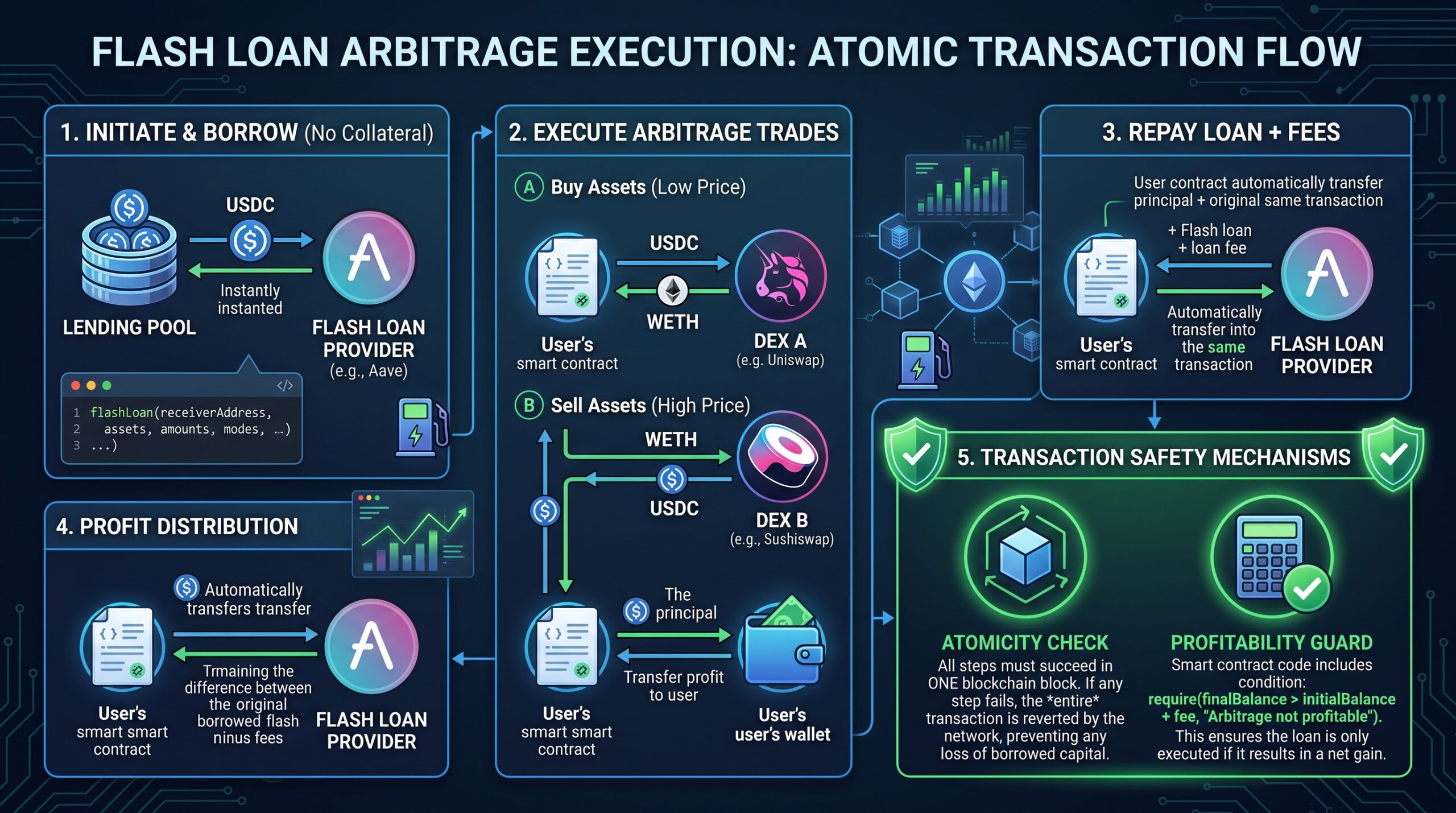
Flash loans have revolutionized the DeFi landscape, allowing anyone to borrow millions in assets—provided they return them within the same transaction block. This atomicity is your ultimate safety net. If the trade is profitable, you keep the gains; if it fails, the transaction reverts as if it never happened. Let’s break down how to architect these zero-capital trades with the precision required to survive in 2026.
The Atomic Safety Net: Why Flash Loans Are Unique
A flash loan is fundamentally different from traditional credit. In standard finance, you post collateral and hope for the best. In DeFi, the smart contract governing the loan enforces a simple rule: the borrowed capital, plus fees, must be returned by the time the block finishes processing.
Expert Insight: Think of this as a “self-destruct” mechanism for risk. Because the entire operation—borrowing, trading, and repaying—occurs in a single transaction, there is zero counterparty risk for the lender. For you, it means your only real “loss” is the gas fee spent on a failed transaction. If your arbitrage logic is flawed, the blockchain simply rolls back the state, protecting you from losing the borrowed funds.
Structuring the Execution Logic
Successful flash loan arbitrage isn’t about speed alone; it’s about the logic embedded within your smart contract. You must be able to calculate the optimal trade volume on-chain before committing to the swap. If you borrow $1M but the liquidity pool on the second exchange only has $500k, you’ll trigger massive slippage and lose money.
Personal Example: I once built an arbitrage bot that performed beautifully in a simulator. When I deployed it to mainnet, I realized I hadn’t accounted for the gas costs of multi-hop swaps. I was “profitable” on paper but losing money in reality. I had to add a require() statement that checks if the net profit (after gas and protocol fees) is greater than zero before finalizing the repayment. If the math doesn’t work, the transaction reverts instantly.
The Critical Role of Private RPCs
In 2026, the biggest threat to your arbitrage isn’t market volatility; it’s being “front-run” by MEV (Maximal Extractable Value) bots. If you broadcast your transaction to the public mempool, these bots will see your profitable trade, copy it, and pay a higher gas fee to get theirs included in the block first. You end up with a failed transaction while they walk away with your profit.
Expert Insight: Never send your arbitrage transactions to the public mempool. Use services like Flashbots or private RPCs that send your transaction directly to validators. By keeping your trade “in the dark” until it’s bundled into a block, you ensure that no one can copy your strategy. This single change is often the difference between a bot that earns and one that just pays for gas.
Security: Auditing the “One-Block” Logic
Writing the contract is the easy part; ensuring it cannot be exploited is the real challenge. Since your bot is essentially an autonomous agent, any vulnerability in your code becomes an open invitation for hackers to drain the liquidity you are borrowing.
-
Restrict Access: Always use
Ownableor similar modifiers so that only your wallet can trigger the trade. You don’t want a random user calling your contract and draining the gas balance. -
Slippage Protections: Hard-code maximum slippage thresholds. If the DEX price deviates by more than 0.5%, your contract should revert to prevent the trade from executing at a loss.
-
Unit Testing: Use frameworks like Hardhat to simulate every possible market condition, including “empty pool” scenarios and extreme network congestion.
Conclusion
Flash loan arbitrage is one of the few areas in crypto where your technical skill—not your bank balance—determines your success. By combining atomic transactions with private execution pathways and strict on-chain validation, you can turn fleeting market inefficiencies into consistent gains. Start by testing on a local fork, refine your slippage logic, and prioritize privacy over everything. The market is constantly moving, and with the right architecture, you can be the one capturing the spread.
FAQ
Can I use flash loans on any blockchain?
Most major EVM-compatible chains (like Ethereum, Arbitrum, and Polygon) support flash loans. However, the profitability of your bot will depend heavily on the gas costs and the liquidity depth of the DEXs on that specific chain.
What is the “fee” for a flash loan?
Most protocols, like Aave, charge a small percentage (typically 0.09%) of the borrowed amount. You must include this cost in your on-chain profit calculation to ensure your trade is actually net-positive.
How do I handle gas fee spikes?
Use dynamic gas estimators in your backend logic. If the estimated gas fee exceeds your expected profit margin, your bot should be programmed to skip the trade entirely.
Is this truly “zero-capital”?
While you don’t need capital for the trade, you do need a small amount of native network tokens (like ETH or MATIC) in your wallet to cover the transaction gas fees.
Prompt for Image Generation: