You have likely deposited your assets into a high-yield vault, feeling satisfied with the advertised APY, only to find that weeks later, the actual rewards are nowhere near what you expected. We have all been there. You are hunting for alpha, but the reality of decentralized finance (DeFi) is that “yield” is a moving target. If you aren’t actively managing your yield operations with automated tracking and rigorous audits, you are essentially flying blind in a high-speed market.
Professional DeFi participants don’t “set and forget.” They build systems. They treat their yield positions like a business, constantly monitoring for decay, fee changes, and protocol integrity. If you want to stop losing money to “silent” yield rot, it is time to upgrade your management stack from simple wallet checks to a proactive, automated operational framework.
The Reality of Yield Decay and Operational Drag
Most users treat APY as a static number, but yield in DeFi is dynamic and prone to rapid decay. As more liquidity flows into a pool, your share of the rewards inevitably shrinks. Furthermore, hidden costs—like compounding gas fees, changing management fees, or impermanent loss in liquidity provider (LP) positions—often eat into your principal faster than the rewards can replenish it.
Expert Insight: Stop looking at gross APY and start calculating your “Net Realized Yield.” This is your gross rewards minus all gas spent on harvesting, swapping, and re-depositing. I personally keep a simple ledger that tracks the “gas-adjusted” return of every vault I touch. If a vault is paying 20% but costs me 5% in gas fees to harvest efficiently, I’m not really earning 20%.
Automating Your Tracking Infrastructure
Manual tracking is a relic of the past that invites human error. When you have assets spread across multiple protocols, chains, and wallets, you need a unified dashboard. You should be using portfolio trackers that pull live on-chain data to show your real-time performance, including historical rewards and cost basis.
Personal Example: I used to rely on my brain to remember my entry prices and harvest dates. It worked until I had fifteen different positions, at which point I realized I couldn’t tell which ones were actually profitable. Now, I use API-linked trackers that send alerts if a protocol’s TVL (Total Value Locked) drops significantly or if the reward emission schedule changes. It transformed my management from a “guessing game” into a data-backed routine.
The Necessity of Routine Protocol Audits
Even if a protocol is audited by a top firm, code is never “finished.” Upgrades, governance changes, and bridge vulnerabilities mean that your risk profile can change overnight. You must treat your yield operations as an ongoing audit process, not a one-time security check.
Expert Insight: Create a “Protocol Health Checklist.” Every month, check the protocol’s recent governance proposals, monitor the core developer activity, and verify that the multisig signers haven’t changed. If you aren’t doing this, you are trusting your capital to code that you haven’t bothered to look at in months. Never be the last person to know when a vault has become a security liability.
Implementing Automated Alerting Systems
The markets move faster than you can check your phone. You need a system that alerts you before a potential crisis happens, rather than after. By setting up custom monitors for protocol liquidations, drastic TVL shifts, or oracle failures, you can react to risks before they impact your liquidity.
Expert Insight: Use “On-Chain Monitoring” tools to watch your specific smart contracts. If you are deeply invested in a particular strategy, set an alert for any transaction involving the “owner” or “admin” address of that vault. If you see an unexpected admin move or a massive withdrawal from the vault, you will have the lead time to pull your capital before the wider market reacts.
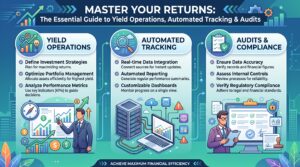
Yield operations are a serious commitment that requires the same discipline as institutional asset management. By automating your tracking, calculating your net yield, and conducting routine audits, you turn your passive investments into a robust, high-performance portfolio. Take control of your data today, build your monitoring systems, and stop settling for the “advertised” numbers. The difference between a profitable DeFi investor and a victim of yield rot is simply the quality of their system.
FAQ
What is the best way to track net realized yield? Use a combination of on-chain portfolio trackers and a custom spreadsheet. The tracker gives you real-time data, while your spreadsheet allows you to input your specific gas costs and entry fees for a true ROI calculation.
How often should I audit the protocols I’m using? A monthly deep dive is a good baseline, but if you have a significant portion of your portfolio in one vault, check the protocol’s recent GitHub activity and governance forums weekly.
What are the most common “hidden” costs in yield farming? Gas fees (especially on Ethereum), exit/deposit fees, platform management fees (performance fees), and the hidden cost of impermanent loss if you are in a volatile LP pair.
Can I automate my yield harvesting? Yes, several “auto-compounding” protocols exist that do this for you. However, understand that you are adding a layer of risk—you now have to trust the auto-compounder’s smart contract and the underlying vault’s contract.