You have likely stared at your crypto charts, watching price bounce erratically between indicators that seem to contradict each other. We have all been there. Most traders treat Fibonacci retracements and Pivot Points as separate, standalone tools, applying them in isolation and wondering why their “sure-fire” entry levels fail to hold. If you want to trade with institutional-grade precision, you must stop using these tools as individual signals and start viewing them as overlapping layers of market structure.
This is the power of confluence. When a specific Fibonacci retracement level aligns perfectly with a Pivot Point, you aren’t just looking at a price point; you are looking at an algorithmic “magnet” that institutional trading bots are programmed to respect. Let’s break down how to architect this confluence to sharpen your edge in volatile crypto regimes.
The Architecture of Algorithmic Confluence
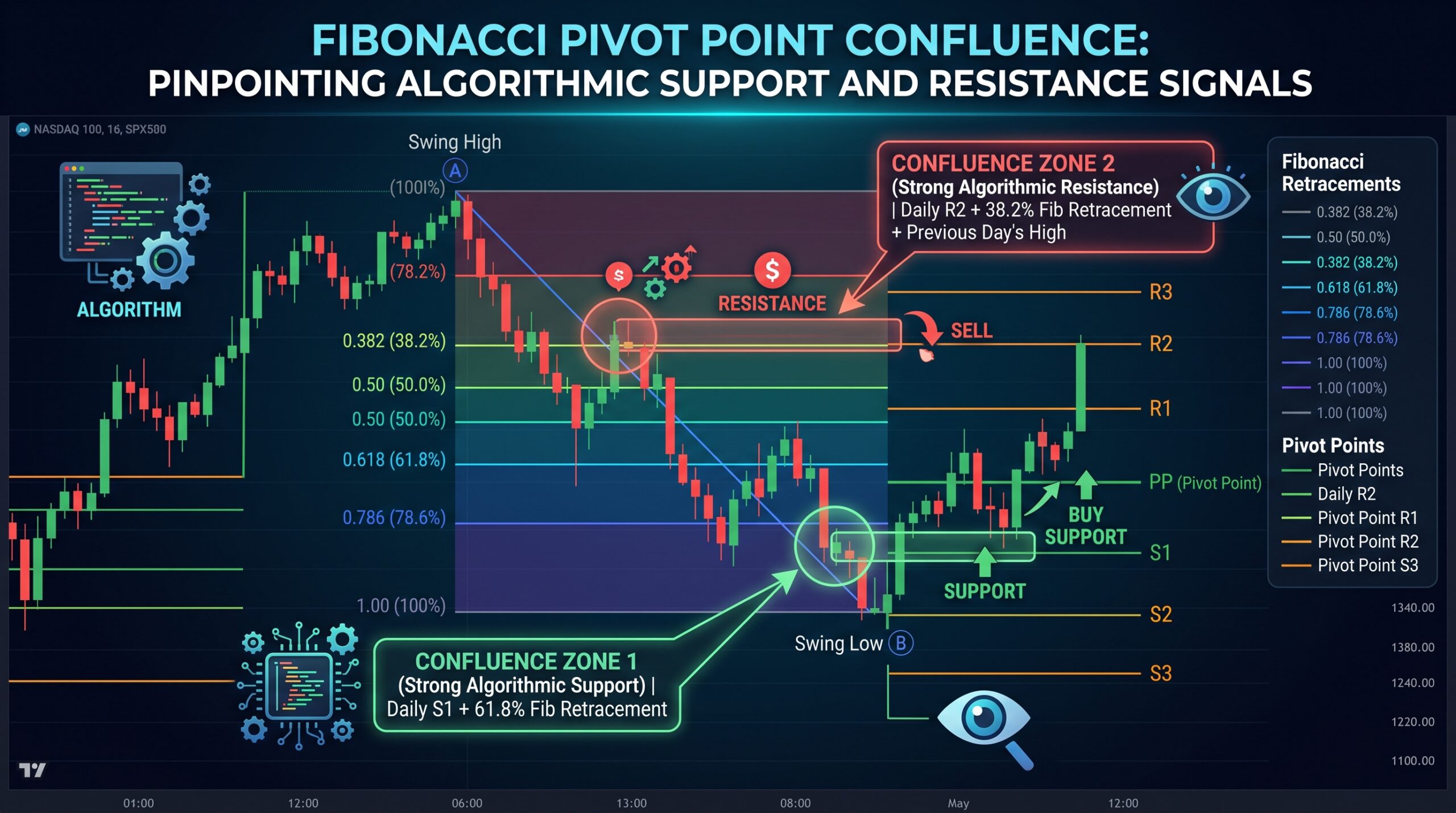
Confluence is the intersection of two or more independent analytical methods that point to the same price level. In high-frequency trading, computers aren’t just looking for one indicator; they are programmed to trigger buy or sell orders when multiple technical conditions align. By combining Fibonacci sequences (which map natural market psychology) with Pivot Points (which map the objective, mechanical boundaries of the previous session’s price action), you align your trades with the same math that drives institutional algorithms.
Expert Insight: When you see a Fibonacci 61.8% “Golden Ratio” retracement sitting within a few pips of an R1 or S1 Pivot Point, that zone is no longer just a line on a chart. It is an area of heightened liquidity. If you’re trading without this overlap, you’re basically betting against the market’s underlying mechanical structure.
Setting Up Your Workspace for Precision
To execute this, you need a clean chart. Overloading your screen with too many indicators will destroy your ability to see the price action itself. Start by setting your Pivot Points to “Daily” for intraday scalping or “Weekly” for swing trading. Then, apply your Fibonacci tool using the most recent significant swing high and low.
Personal Example: I once missed a perfect long entry on Bitcoin because I was only looking at the 61.8% Fibonacci level. I didn’t notice that the daily S1 Pivot Point was sitting right at the 78.6% level just below it. The price wicked through my 61.8% entry, hit the Pivot confluence, and then rallied 5%. Since then, I’ve made it a rule: I never enter a trade unless I have at least two structural reasons—like a Pivot/Fib alignment—to justify the risk.
Decoding the Signal: The 2-of-3 Rule
You shouldn’t trade every time a Fibonacci level touches a Pivot point. Instead, look for a third “confluence factor” to confirm the setup. This could be a round number (like $50k Bitcoin), a previous structural support/resistance flip, or a simple volume cluster.
-
Zone Identification: Map your zones on higher timeframes (4-hour or Daily) first to get the “big picture” bias.
-
The “Wait and See” Trap: Never market-order into a confluence zone. Wait for price to reach the zone and look for a lower-timeframe confirmation, such as a bullish hammer or an RSI divergence.
-
Stop-Loss Placement: Always place your protective stop-loss behind the next level of confluence. If you are entering on a Fibonacci/Pivot support, tuck your stop safely below the S2 Pivot level or the 78.6% Fib extension.
Why This Strategy Survives Volatility
Crypto markets are notoriously “noisy,” with fake-outs occurring every few minutes. Most indicators are reactive, but Fibonacci Pivot confluence is predictive. Because these levels are calculated based on the previous session’s objective data (High, Low, Close), they act as a map for the day ahead. Algorithms are hard-coded to recognize these levels, meaning they become self-fulfilling prophecies. By trading here, you aren’t fighting the bots—you are trading right alongside them.
Fibonacci Pivot confluence is not a “magic button” that guarantees profit; it is a filter for high-probability setups. By stopping the spread of indicators across your chart and focusing on these specific points of overlap, you transform your trading from a game of chance into a disciplined exercise in probability. Stop gambling on single indicators and start stacking your confluences. Your future self—and your portfolio—will thank you for the extra bit of discipline.
FAQ
Can I use this strategy on any crypto asset?
Yes, but it works best on high-liquidity assets like Bitcoin or Ethereum. Lower-cap coins often lack the institutional order flow that makes these algorithmic levels so reliable.
Does it matter if I use logarithmic or linear charts?
For intraday trading with pivots, linear is standard. For long-term swing trading, logarithmic scales are generally more accurate for drawing Fibonacci levels over large price swings.
How many confluences are “enough”?
Two is a great start. Three is excellent. If you find four or more, you have found a “gold mine” setup that is worth significant focus.
Where can I find Fibonacci Pivot indicators?
Most platforms like TradingView have built-in “Fibonacci Pivot” indicators. Simply search in the Indicators tab, and ensure you are using a version that allows you to customize the daily/weekly inputs.