You have likely watched your portfolio swing wildly during a Federal Reserve press conference, wondering why a change in interest rate guidance ripples so violently through the crypto markets. We have all been there. Most retail traders view crypto as a self-contained ecosystem governed by code and community sentiment, but that is a dangerous simplification. The truth is that Bitcoin, Ethereum, and the broader digital asset space have become the high-beta version of traditional tech equities, anchored directly to the pulse of global central bank liquidity.
If you aren’t paying attention to the “liquidity regime,” you are playing in a casino without knowing if the house is adding chips to the table or pulling them away. Understanding the Fed’s cycle isn’t just for macro economists; it is a fundamental survival skill for any crypto trader looking to navigate 2026 and beyond.
The Liquidity Barometer: Why Crypto Isn’t Decoupled
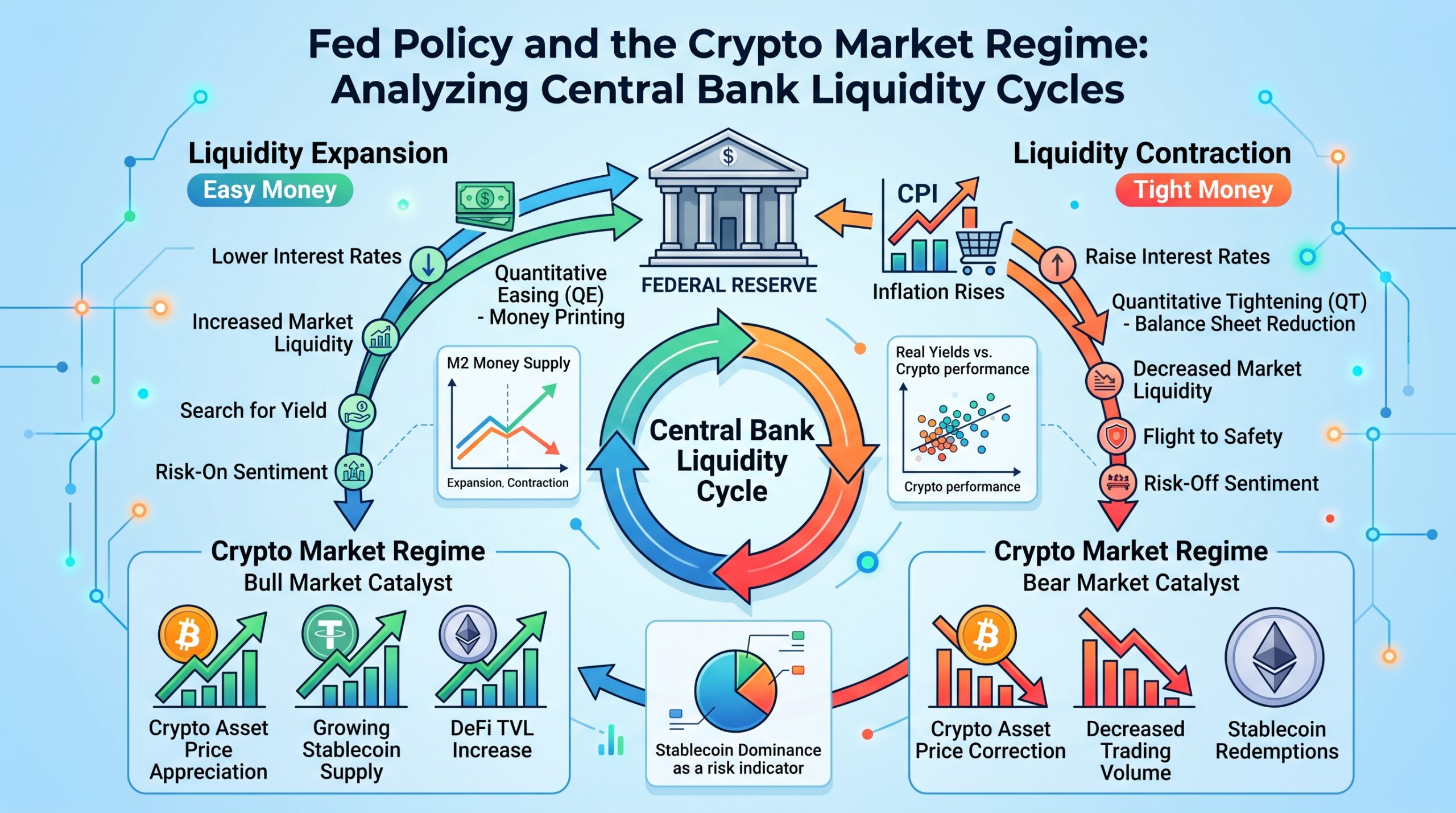
The original promise of crypto was a parallel financial system, but institutional adoption has tethered it to the legacy world. When the Fed expands the money supply—through quantitative easing or lower rates—that extra capital inevitably finds its way into “risk-on” assets. Crypto, being the most speculative and liquid of these assets, acts as a high-velocity sponge for this excess cash.
Expert Insight: Think of the Federal Reserve as the “plumbing” for the global financial system. When the Fed holds rates steady or cuts them, liquidity leaks out of safe, yield-bearing assets (like Treasury bonds) and drips into speculative ones like crypto. Conversely, when the Fed tightens, it creates a “vacuum” effect, pulling liquidity out of the riskiest corners of the market first. In 2026, with rates hovering between 3.5% and 3.75%, we are in a regime where every FOMC meeting is a battle between inflationary pressure and the need for market stability.
Decoding the 2026 Policy Landscape
As of June 2026, the market is navigating a complex environment where rate holds are the norm, yet hawkish rhetoric remains a constant threat. While institutions like Bank of America have signaled potential hikes to combat persistent inflation, the reality is that the Fed is walking a tightrope. Every time a new “Warsh-era” policy shift is teased, the crypto market reacts in milliseconds.
Personal Example: I’ve shifted my own strategy to focus on the “Dot Plot” rather than just the headline interest rate. The market doesn’t trade on where rates are; it trades on where they are going. When you see traders front-running an expected rate cut, they are essentially betting on a future expansion of global M2 money supply. If that expansion doesn’t materialize, the “sell the news” event is often brutal.
Identifying Liquidity Cycles in Your Charts
You can actually visualize these cycles if you overlay global liquidity metrics onto your price charts. When you look at the correlation between Bitcoin and the M2 money supply, you’ll notice that major bull runs don’t just happen because of “adoption”—they happen when the Fed pivots to liquidity expansion.
Expert Insight: Don’t treat these correlations as static. There are periods where crypto decouples due to idiosyncratic events (like a major regulatory breakthrough or a localized supply shock). However, over a 12-month rolling window, the correlation remains undeniable. If you see the Fed tightening (QT) while price is rallying, be cautious—you are likely witnessing a liquidity trap.
Risk Management in a Tightening Regime
When the Fed is hawkish, the market punishes “zero-cash-flow” assets. Since most crypto tokens don’t pay dividends or rents, their valuation is entirely based on future expectations. In a high-rate environment, the “discount rate” applied to those future expectations increases, causing prices to compress.
-
Position Sizing: Reduce your leverage during FOMC weeks. The volatility is often generated by high-frequency bots reacting to the nuance in the Fed’s tone, not the actual decision.
-
Asset Quality: In tightening cycles, capital flees to “quality.” Focus on the large-cap assets with the strongest fundamentals and lowest regulatory risk, as they are the last to be liquidated when the liquidity tap closes.
-
The “Wait and See” Approach: Sometimes, the best trade is no trade. If the macroeconomic signal is too noisy, let the liquidity regime stabilize before you commit significant capital.
The Federal Reserve is the silent partner in your crypto portfolio. You can choose to ignore its policy shifts, but you cannot ignore the impact those shifts have on your bottom line. By monitoring central bank liquidity cycles and aligning your risk profile with the current regime, you move from being a passenger in the market to an informed operator. Don’t trade in a vacuum—stay ahead of the macro trend, and you’ll find yourself on the right side of the liquidity wave.
FAQ
Why does crypto drop when interest rates stay high?
High interest rates make “safe” assets like government bonds more attractive. This draws money out of risky investments like crypto and moves it into these lower-risk, yield-bearing alternatives.
What is the “Dot Plot,” and why does it matter?
The Dot Plot is a chart published by the Fed showing where each committee member thinks interest rates will be in the future. It is a vital tool for predicting future liquidity changes, which drives market sentiment long before the actual rate changes occur.
How does a stronger US Dollar affect Bitcoin?
Most crypto is priced in USD. When the dollar is strong—often a result of high interest rates—it becomes “more expensive” to buy Bitcoin, which creates natural downward pressure on the price.
Is Bitcoin still an inflation hedge?
The 2022 bear market largely debunked the idea of Bitcoin as a short-term inflation hedge. Instead, it has shown itself to be a “liquidity asset” that performs best when the money supply is expanding.