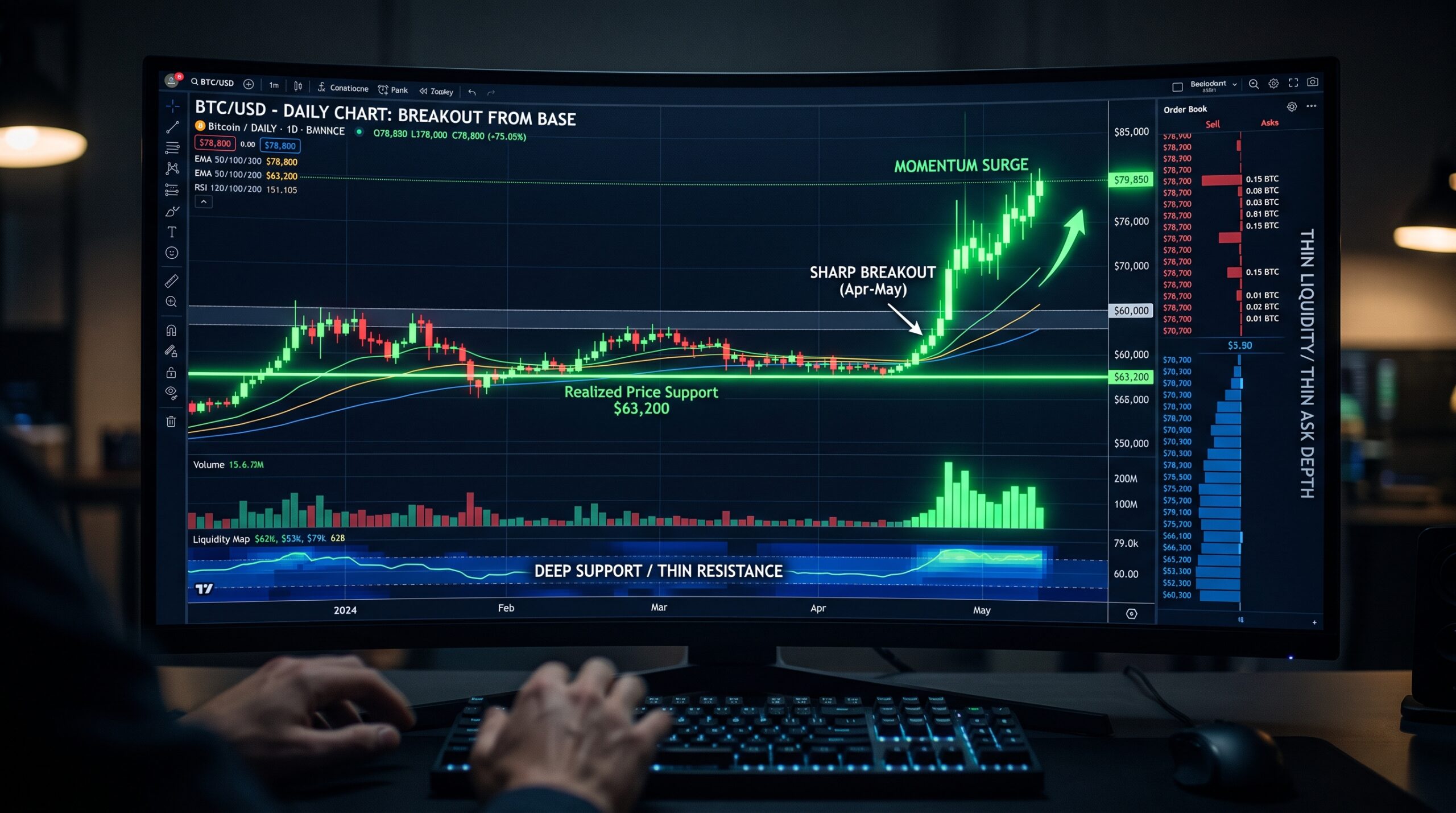
You have watched Bitcoin grind through a tight range for weeks. Price held the important $63,200 median realized price while volume stayed thin and participation looked exhausted. Now the tape has woken up. Bitcoin pushed toward the high $70,000s, yet Bitfinex analysts still flag the same core issue: the next large directional move looks more likely to favor buyers, but genuine liquidity has not fully returned to the market.
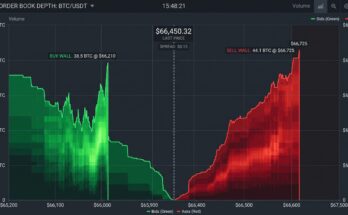
That combination creates both opportunity and risk. Thin order books can amplify any real buying. They can also turn small selling into sharp downside moves. The structure is constructive. The fuel is still incomplete.
Why Bitfinex Sees Higher Odds for an Upside Break
Bitfinex analysts pointed to Bitcoin’s prolonged defense of the median realized price near $63,200 as a key signal. Holding that level for an extended period raises the probability that the next volatility expansion breaks higher rather than lower. They identified $67,176 as the critical short-term holder realized price. A sustained move above it would put recent buyers back into profit and open the path toward higher supply zones.
The logic is straightforward. When the average cost basis of recent participants sits just overhead and price refuses to break lower for weeks, sellers lose conviction. Buyers start to regain control. Failure to hold $63,200 would flip that setup and open the door toward $57,800 and potentially the longer-term aggregate realized price near $52,700.
I have tracked these realized-price levels across multiple cycles. They often act as psychological and technical hinges. Price spends time building energy around them before the next decisive expansion. The current setup fits that pattern.
The Liquidity Problem That Still Needs Solving
Macro conditions have improved. Inflation data cooled, rate-cut expectations rose, and traditional risk assets responded. Equities pushed higher. Bitcoin lagged. The missing piece, according to Bitfinex, is the final transmission of that easier financial environment into actual crypto capital flows.
US spot Bitcoin ETFs recorded periods of net outflows even as the broader market strengthened. Stablecoin supply contracted from its May peak. Spot trading volumes compressed toward multi-year lows. Transfer velocity on the Bitcoin network dropped to levels last seen years earlier. In that environment, even modest order flow can move price more than usual.
Thin liquidity cuts both ways. A sustained return of ETF inflows combined with expanding stablecoin supply would signal that the liquidity transmission mechanism has restarted. Until that happens, rallies remain vulnerable to exhaustion.
What Changed in the Most Recent Push Higher
The market did not stay quiet. Bitcoin broke higher with force, climbing more than 20 percent in a week and briefly testing levels near $79,000–$80,000. Bitfinex later noted that this advance looked healthier than a pure short squeeze. Open interest rose only modestly while price advanced 10–11 percent in key sessions. That pattern points to spot buying and short covering doing most of the work rather than fresh leverage stacking up.
ETF flows flipped positive with strong multi-day inflows. That provided real demand. Still, the analysts cautioned that a large volume of coins now sit in profit and have moved toward exchanges. If that supply hits the market in size, it could produce the biggest profit-taking wave of the year.
The $68,000–$69,000 zone has become the new key support area because it aligns with the short-term holder cost basis. Holding that band keeps the recovery intact. Losing it would reopen the earlier range and test the conviction of the recent buyers.
Practical Levels and Risk Management Right Now
If you are positioned long, the $68,000–$69,000 region is the first place to watch closely. A clean daily close back below it would argue for reducing size or tightening stops. Above that zone the path of least resistance remains higher, with previous range highs and psychological levels further up acting as progressive targets.
New capital can wait for either a successful retest of the $68,000–$69,000 area with rising volume or a decisive expansion in ETF flows and stablecoin supply before adding aggressive size. Thin liquidity means gap risk is elevated in both directions. Position sizing should reflect that reality.
Broader macro still matters. Long-end Treasury yields remain a pressure point for risk assets. Any sharp rise in yields can quickly reverse risk appetite. Conversely, continued softness in yields and further evidence of liquidity returning to crypto would support the upside case Bitfinex outlined.
How to Position for the Next Expansion

The setup Bitfinex described still holds. Bitcoin defended a critical realized-price level for weeks, raising the odds that the next major move favors the bulls. Liquidity has begun to reappear through ETF demand, yet the broader measures of market participation and stablecoin growth have not fully confirmed a durable shift.
Watch the $68,000–$69,000 support, ETF flow numbers, and stablecoin supply trends. Those three data points will tell you whether the liquidity gap is closing or widening. Have a clear plan for both the continuation and the failed-breakout scenarios before the next large candle prints.
The market rewards those who respect both the structure and the missing fuel. Stay focused on the levels that actually matter.
FAQ
What is the key level Bitfinex highlighted for Bitcoin?
They flagged the median realized price near $63,200 as important support and the short-term holder realized price around $67,176 as the level that would put recent buyers back into profit and raise the odds of an upside volatility expansion.
Why does liquidity still matter if price has already rallied?
Thin participation amplifies both buying and selling. Without sustained ETF inflows and expanding stablecoin supply, rallies remain vulnerable to sharp reversals once the initial momentum fades.
Is the recent Bitcoin rally a short squeeze?
Bitfinex noted that open interest rose only modestly while price advanced, pointing to spot demand and short covering rather than heavy new leverage. That structure typically has more staying power than pure squeeze-driven moves.
What happens if Bitcoin loses the $68,000–$69,000 zone?
That area now aligns with the short-term holder cost basis. A sustained break below it would weaken the recovery and reopen the earlier trading range.
How can traders prepare for the next move?
Define risk around the $68,000–$69,000 support, monitor ETF flows and stablecoin supply for confirmation of returning liquidity, and size positions for elevated volatility while order books remain relatively thin.