One sharp move against your position and the account balance vanishes. Liquidation feels sudden, yet it usually follows a series of small mistakes that compound under leverage.
Many beginners treat 5x or 10x as moderate. In crypto’s fast markets, those levels already amplify both gains and losses dramatically. Learning how to size positions, place stops, and manage margin correctly makes the difference between surviving long enough to improve and blowing up repeatedly. Here are practical methods that help new traders use modest leverage more safely.
Understand Exactly How Liquidation Works
Liquidation occurs when your margin balance can no longer cover the required maintenance margin. The exchange automatically closes the position to prevent further losses. Higher leverage brings the liquidation price closer to your entry.
At 10x leverage, a 10% move against you can wipe out the position if no extra margin exists. At 5x, it takes roughly a 20% adverse move under similar conditions. Funding rates, fees, and sudden volatility can push you to liquidation even sooner than the simple calculation suggests.
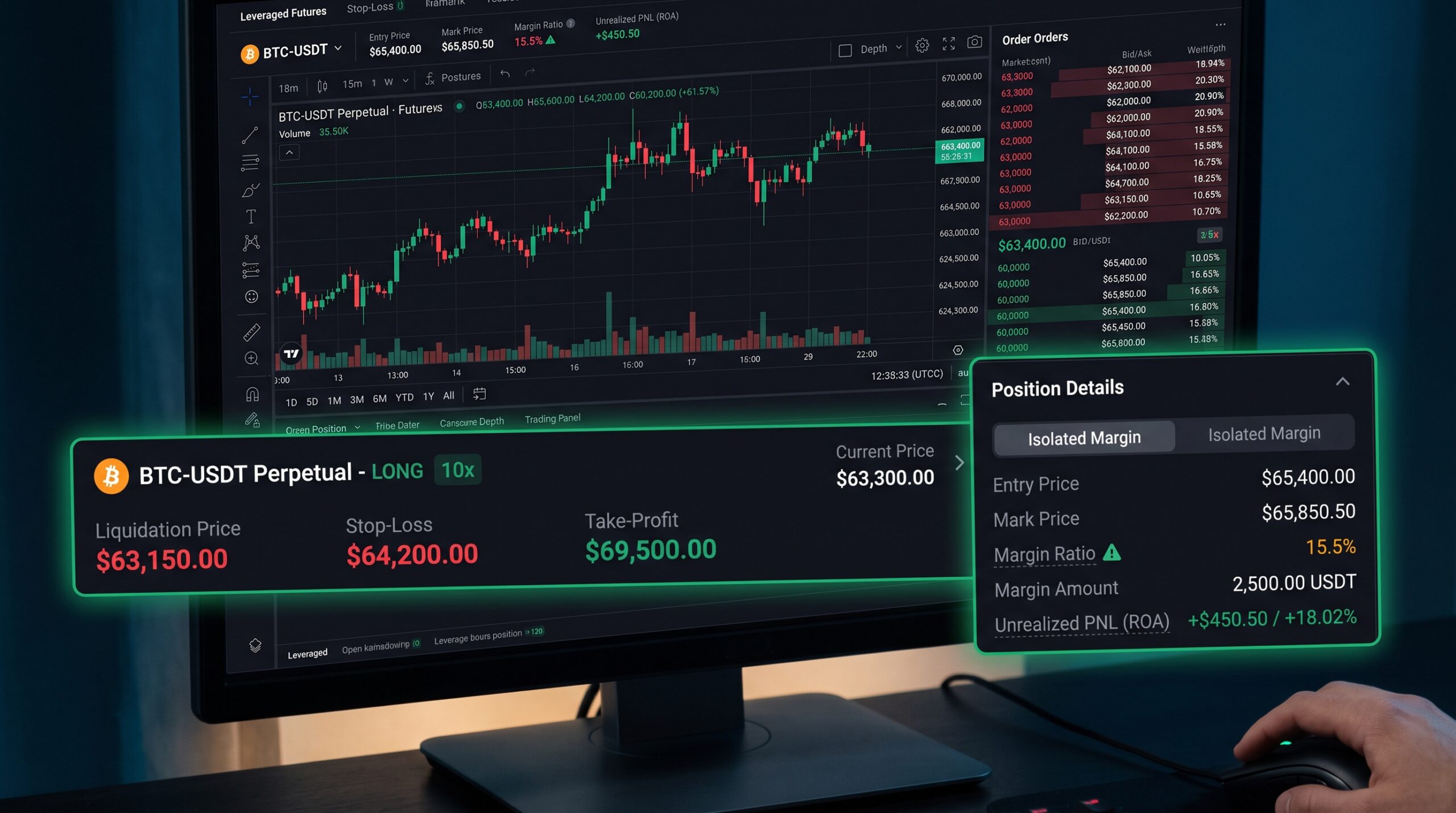
Always check the liquidation price displayed by the exchange before entering. If that price sits too close to current market levels, the risk is already too high.
Position Sizing Is Your First Defense
Never decide position size based on how much you want to make. Decide it based on how much you are willing to lose. A common guideline is risking only 0.5% to 1% of total trading capital on a single trade.
Calculate the distance from your entry to your stop-loss. Then size the position so that if the stop is hit, the loss stays within your predetermined risk limit. Leverage then becomes a tool to achieve that position size rather than a number chosen for excitement.
Traders who skip this step often discover that even a “small” 5x or 10x position can represent far more risk than their account can handle. Consistent position sizing prevents one bad trade from ending the account.
Choose Isolated Margin and Set Hard Stops
Isolated margin limits the risk to the amount you assign to that specific position. Cross margin can pull funds from the rest of your account and lead to larger, unexpected liquidations. Most beginners should default to isolated margin.
Place a stop-loss immediately after entering. Mental stops rarely work when volatility spikes. A hard stop forces discipline and defines the exact point where the trade thesis is invalidated.
Some traders add a small buffer of extra margin to isolated positions to survive brief wicks. This technique can help, but it should not replace proper stop placement or encourage oversized positions.
Manage Leverage According to Market Conditions

Use lower leverage during high-volatility events, major news releases, or when trading less liquid pairs. Even 5x can become dangerous when candles start running 8–15% in minutes. In calmer conditions, some traders cautiously apply 5x to 10x on major pairs with tight risk controls.
Avoid the temptation to increase leverage after a winning streak. Confidence often peaks right before a sharp reversal. Stick to a predetermined maximum leverage and reduce it when uncertainty rises.
Keeping a simple trading log that records leverage used, position size, and outcome helps identify patterns in what actually works for your style.
FAQ
Is 10x leverage safe for beginners?
It can be manageable only with strict position sizing and hard stops. Many beginners are better served starting at 2x–5x until they gain consistency.
What is the main cause of liquidation?
Oversized positions relative to account balance and stop distance, often combined with the use of cross margin.
Should I use isolated or cross margin?
Isolated margin is generally safer for beginners because it contains losses to a single position.
How much of my account should I risk per trade?
Many disciplined traders risk 0.5% to 1% of total capital on any individual trade.
Can funding rates cause liquidation?
Yes. Persistent funding payments in one direction reduce margin over time and can push a position closer to liquidation.
Build Habits That Keep You in the Game
Leverage between 5x and 10x is usable when treated with respect. The traders who survive long enough to improve are those who prioritize position sizing, isolated margin, and hard stops over the pursuit of fast gains.
Start smaller than you think necessary. Track every trade and review your liquidation near-misses. Consistency in risk management matters far more than finding the perfect entry. Master these fundamentals and you give yourself the time needed to develop real skill.