You want the security of holding your own keys, yet you still need fast access to deep exchange liquidity for trading. Moving funds back and forth between self-custody and a centralized platform creates friction, fees, and timing risk.
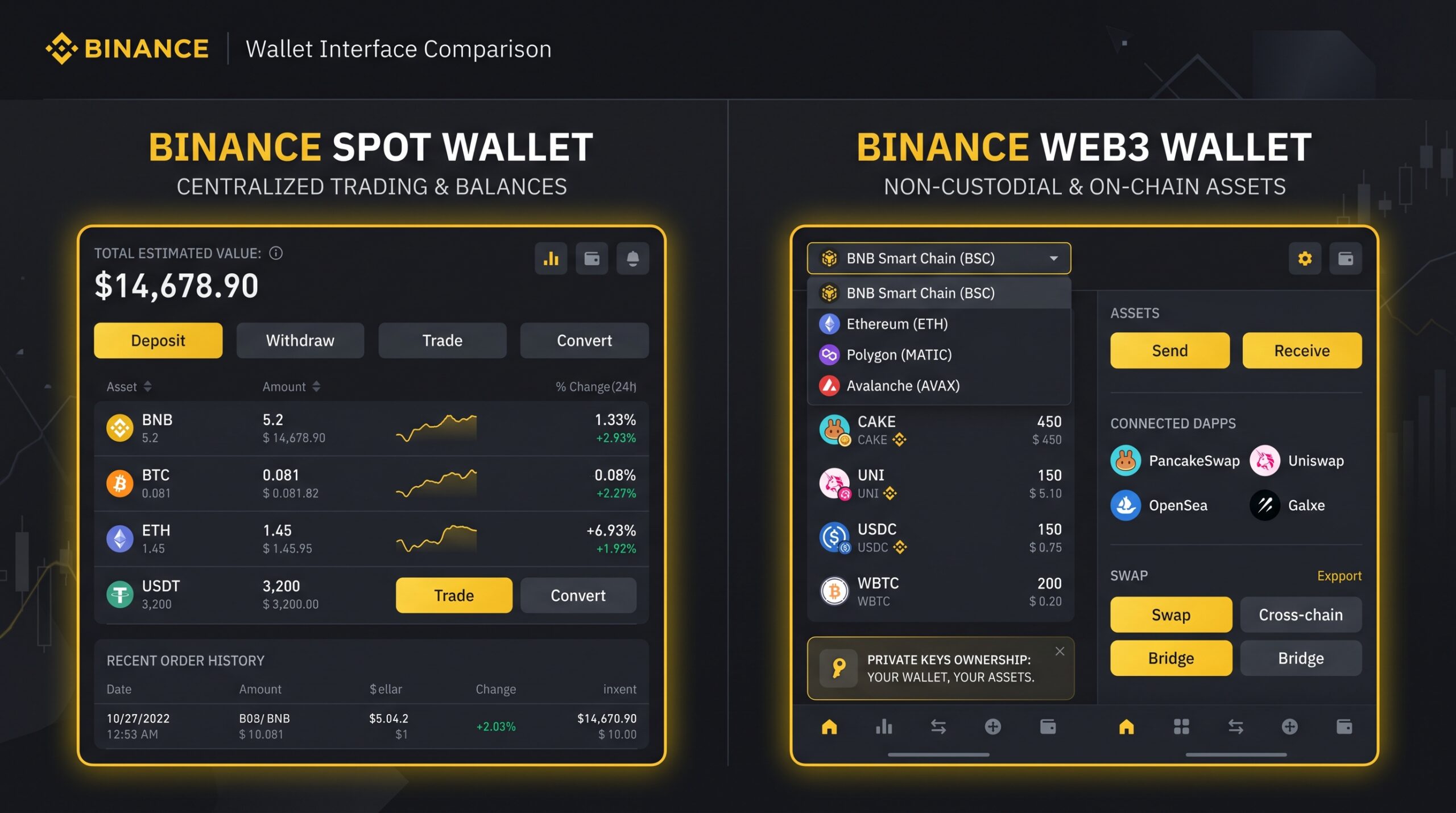
Binance offers two distinct tools that address different sides of this problem: the Spot Wallet and the Web3 Wallet. One keeps assets inside the exchange ecosystem for maximum trading efficiency. The other gives you non-custodial control while still connecting to Binance services. Understanding the strengths and limits of each helps you manage both security and liquidity more deliberately.
What the Binance Spot Wallet Is Designed For
The Spot Wallet holds the assets you deposit directly onto Binance for trading, earning, or conversions inside the platform. Funds remain under Binance’s custody, which allows instant access to the order books, launchpad events, simple earn products, and other exchange features.
This setup prioritizes speed and convenience. You can move between spot trading, funding, and earn accounts with almost no delay. Liquidity is immediately available, and you avoid the confirmation times and gas fees that come with on-chain transfers.
The trade-off is clear. You do not control the private keys. You rely on Binance’s security systems, insurance funds, and operational integrity. For active traders who need rapid execution, that trade-off is often acceptable.
How the Binance Web3 Wallet Changes the Model
The Web3 Wallet is a non-custodial wallet built into the Binance ecosystem. You control the private keys or recovery phrase. Assets sit on-chain rather than in Binance’s custody, yet the wallet maintains convenient connections to Binance services and various dApps.
This design gives you true self-custody while still offering a bridge back to exchange liquidity when needed. You can interact with decentralized protocols, hold tokens across multiple networks, and decide exactly when to move value onto the centralized platform.
The experience feels closer to a standalone Web3 wallet, with the added benefit of relatively smooth transfers into the broader Binance environment. Security responsibility shifts to you—seed phrase management, phishing awareness, and transaction verification all become critical.
Key Differences in Security and Control
With the Spot Wallet, Binance manages the private keys and handles most security infrastructure. You benefit from institutional-grade protections but accept counterparty risk. Account takeovers, platform freezes, or extreme stress events remain theoretical possibilities that self-custody avoids.
The Web3 Wallet removes that counterparty risk for the assets it holds. You alone control access. That freedom comes with personal responsibility. Losing the recovery phrase or approving a malicious transaction can result in permanent loss with no recovery option from Binance.
Many users adopt a hybrid approach. They keep long-term holdings or sensitive assets in the Web3 Wallet or cold storage, while maintaining a smaller working balance in the Spot Wallet for active trading. This balances self-custody with practical liquidity needs.
Practical Tips for Managing Both Wallets Effectively

Decide your primary purpose for each balance. Funds required for frequent trading or short-term opportunities usually belong in the Spot Wallet. Assets you intend to hold longer or use across dApps fit better in the Web3 Wallet.
When transferring between the two, double-check networks and addresses. Use small test amounts for any new route. Monitor gas conditions if you move assets across chains, and avoid transferring during periods of extreme network congestion when possible.
Review permissions and connected dApps regularly inside the Web3 Wallet. Revoke access you no longer need. On the Spot Wallet side, enable every available security feature—withdrawal whitelist, two-factor authentication, and anti-phishing codes.
FAQ
Is the Binance Web3 Wallet truly non-custodial?
Yes. You control the private keys or recovery phrase, and assets remain on-chain under your control.
Can I trade directly from the Web3 Wallet on Binance Spot?
You generally need to transfer assets into the Spot Wallet first to access full centralized order-book liquidity.
Which wallet is safer for large holdings?
Self-custody through the Web3 Wallet or a hardware wallet removes exchange counterparty risk, provided you manage the keys carefully.
Are there fees when moving between Spot and Web3 Wallets?
On-chain transfers involve network gas fees. Binance may also apply its own withdrawal fees depending on the asset and network.
Should beginners use the Web3 Wallet?
Beginners can use it, but they must learn seed phrase security and transaction verification first. Many start with smaller amounts.
Match the Wallet to the Job
The Binance Spot Wallet and Web3 Wallet serve different purposes. One maximizes speed and access to exchange liquidity. The other prioritizes self-custody and on-chain control. Most active users benefit from employing both deliberately rather than choosing only one.
Assess how much capital you need for immediate trading versus longer-term holding. Route funds accordingly and maintain strong security practices on both sides. Clear separation of roles between the two wallets reduces unnecessary risk while preserving the liquidity you need when opportunities appear.