You have likely stared at the interface of a new or smaller crypto exchange, marveling at the tight spreads and apparent depth of the order book, only to get massive slippage when you try to execute a mid-sized order. We have all been there. The illusion of liquidity is a persistent pain point in the fragmented crypto landscape. What you were seeing wasn’t a vibrant ecosystem of thousands of retail traders; it was the engineered output of sophisticated market-making algorithms operating across multiple venues. If you are running an exchange, a brokerage, or managing a large OTC desk in 2026, you cannot rely on native organic volume anymore—you must master cross-exchange liquidity provisioning.
The truth is, liquidity is a commodity that must be “imported.” In this environment, the real players are not gambling on price direction; they are “porting” depth from highly liquid venues (like global titans) to smaller, private order books, capturing a reliable spread while minimizing institutional directional risk. To compete, you have to move beyond simple arbitrage bots and understand the deep, architectural frameworks required for professional liquidity provisioning.
Importing Depth: The Architecture of Liquidity Porting
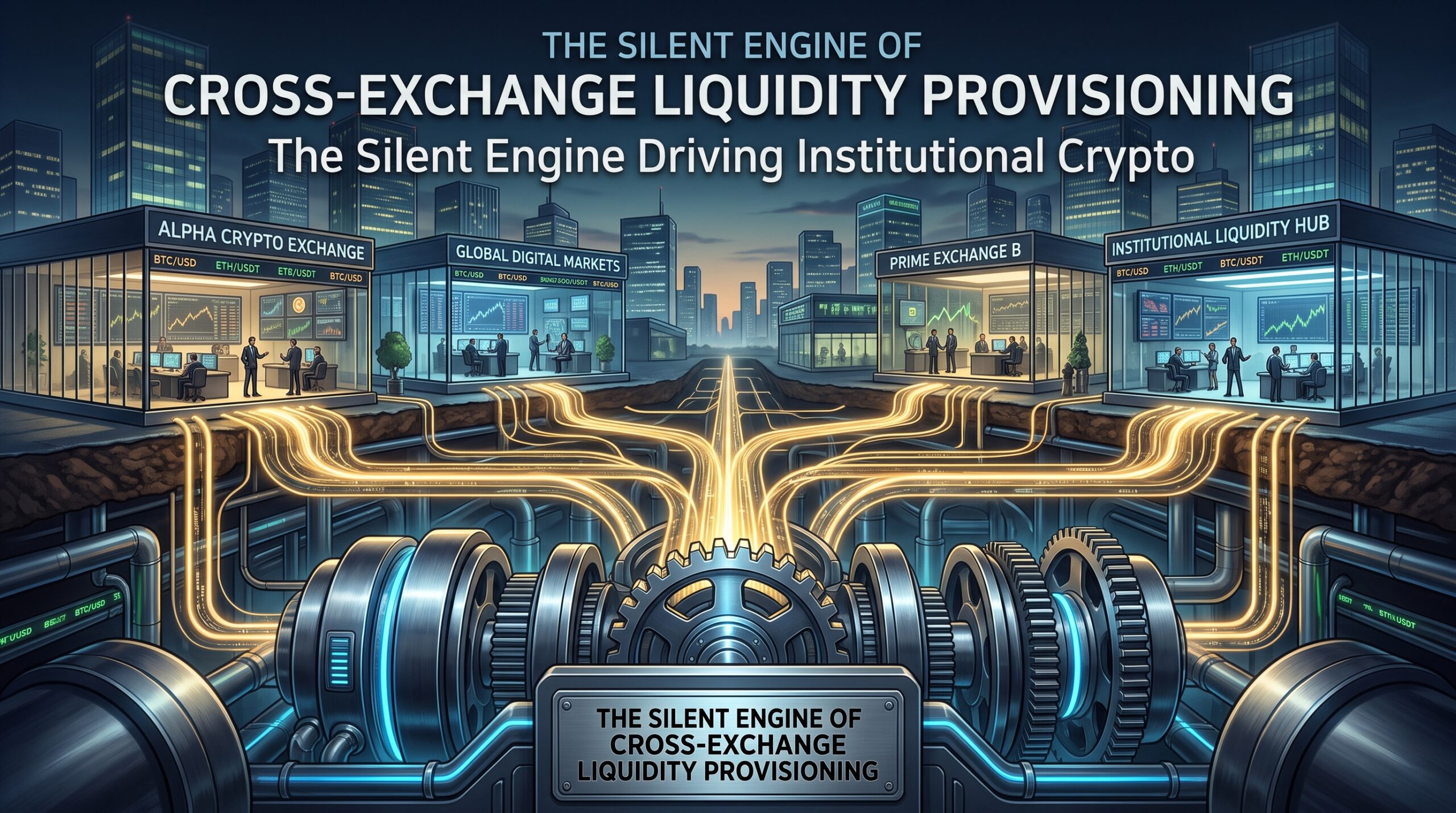
Cross-exchange liquidity provisioning is the sophisticated act of creating a “derivative” order book on your platform that mirrors the real-time depth of a more liquid reference exchange. You are essentially offering your users access to the global liquidity pool from within your private interface, without them ever having to manage multiple exchange accounts. It is a win-win: your platform looks robust and trustworthy, and your users get best-in-class execution.
Expert Insight: When you provision liquidity this way, you aren’t just “showing” orders; you must be prepared to “match” them instantly. If a user on your platform fills an imported buy order, your market-making engine must execute a corresponding market buy on the reference exchange before the price can move against you. This requires sub-millisecond API communication and a specialized engine that simultaneously manages your platform’s native book and your external hedge accounts, ensuring perfect synchronization.
[Image visualizing data lines connecting a large exchange book to a smaller private book]
Frameworks for Profitability: Mastering the “Risk-Adjusted Spread”
Professional market making across venues is a game of mathematics, not a game of luck. You capture profit by quoting a wider spread on your private order book than the one currently available on your reference exchange. Your goal is to keep the “quoted spread” narrow enough to be competitive for your users, while still ensuring it covers all exchange fees (on both platforms), API latency risk, and a defined profit margin.
Personal Example: I remember building an automated system where I quoted a spread that was exactly 10 basis points (BPs) wider than the reference exchange. My logic was simple: 5 BPs would cover my transaction costs on both venues, and 5 BPs would be my net profit. When I didn’t account for volatility spikes, I often lost 2 BPs due to latency—the price moved before I could hedge. I quickly learned to implement dynamic spreads; when the market volatility increases, my engine automatically widens the quoted spread to account for the heightened execution risk.
Navigating API Latency: The Unseen Execution Tax
API latency is the silent killer of profitability in cross-exchange market making. Every millisecond of delay between a user filling an order on your book and your engine executing the hedge on the reference exchange increases the chance of “slippage”—the price moving in an unfavorable direction. If you don’t manage this “execution tax,” a profitable strategy will quickly turn into a capital drain.
Expert Insight: If you want to survive as a market maker in 2026, you must reduce your network proximity. Do not run your market-making engine from a standard cloud server in a random country. Invest in direct, low-latency co-location as close to the reference exchange’s matching engine data center as possible. By shaving off even 50 milliseconds from your execution time, you are effectively increasing your gross margin on every trade, making your low-fee model truly sustainable.
Structural Risk Management: Hedging and Inventory Constraints
You are not trading; you are maintaining inventory. When you provide liquidity, your goal is to stay balanced. A large buy order on your private book should be instantly met with a hedge on the reference venue, leaving you with a neutral market position but a small profit from the spread difference. You must maintain strict inventory controls so you don’t get stuck holding a large, non-hedged directional position.
Expert Insight: The real structural danger is running out of operational capital on either end. If you only have collateral for 1 BTC worth of shorting on the reference exchange, you cannot accept a 5 BTC buy order on your private book. Implementing sophisticated “collateral balancing” is non-negotiable. Your framework must constantly monitor your available hedging capital on all connected venues and automatically adjust the max order size you quote on your private book to prevent an unhedged directional disaster.

Cross-exchange liquidity provisioning is the invisible infrastructure that makes professional trading possible in a fragmented market. By moving past the “guesswork” of directional trading and mastering the algorithmic frameworks of market making, you transform from a participant to a utility. To succeed, you have to prioritize speed, collateral optimization, and mathematical precision over market sentiment. When you focus on building a robust, predictable engine for depth, you stop fearing market volatility—you start profiting from the unique market structures it creates.
FAQ
Do I need massive capital to start market making? Not necessarily, but you need significant operational efficiency. Because you must constantly rotate capital between exchanges to manage hedging collateral, your success depends more on your capital turnover speed than your total capitalization.
Is cross-exchange provisioning the same as “arbitrage”? No. Arbitrage seeks to profit from temporary price discrepancies between exchanges. Liquidity provisioning seeks to profit from the spread you capture while porting volume, regardless of whether the price discrepancy is widening or narrowing.
How does latency impact my profit margin? A profit margin that looks like 10 basis points can easily vanish if a volatility spike causes 15 basis points of slippage during your hedge execution. Latency makes your true cost of execution unpredictable.
What is the “spread-shaving” trap? Beginners often shave their spreads too tight, trying to attract users by beating the global price. They often forget to account for fee structures and “spread-drift,” leading to trades that are high-volume but structurally unprofitable.