You have likely watched your portfolio swing wildly with the market, feeling that familiar dread as your gains from last month vanish in a single red candle. We have all been there. Most traders spend their entire careers chasing “price direction,” trying to guess whether the market will go up or down. But what if you could take the “market” out of your trading entirely?
Delta-neutral basis trading is the secret weapon of quantitative firms and professional market makers. It allows you to ignore the chaotic price action of Bitcoin or Ethereum and instead profit from the structural inefficiency of the market itself. By exploiting the spread between spot and perpetual futures, you can capture yields that exist regardless of which way the market moves.
Understanding the “Basis”: The Market’s Inefficiency
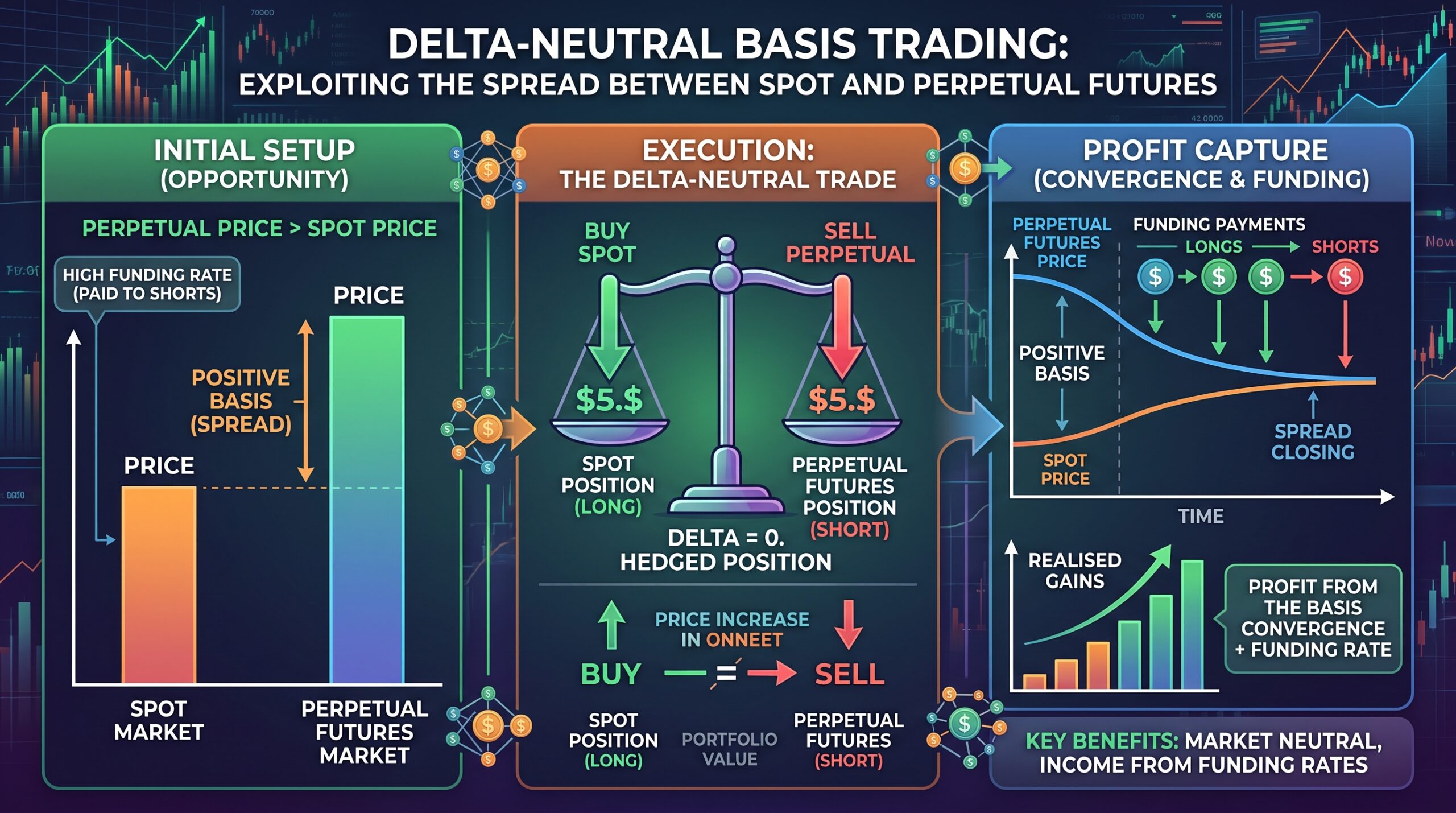
The “basis” is simply the price difference between an asset’s current spot price and its price on the perpetual futures market. In a healthy bull market, futures usually trade at a premium to spot because traders are willing to pay extra for leverage. This gap is the basis, and it is the foundation of your profit.
Expert Insight: When the futures market is more expensive than the spot market, the “basis” is positive. As a basis trader, you are betting that this gap will eventually close as the contract expires or converges, allowing you to capture that premium. It is not a speculative bet on the asset’s future value; it is a mechanical trade on the market’s current state of exuberance.
Executing the Delta-Neutral Hedge
To be “delta-neutral,” you need to cancel out the directional risk of your asset. You do this by buying the asset on the spot market and simultaneously opening an equal-sized short position on the perpetual futures contract. Because you are long and short by the exact same amount, a 5% move in either direction results in a zero net change to your principal.
Personal Example: I remember a specific period where BTC was trading at a 10% premium on futures markets. I bought $10,000 of BTC on the spot exchange and immediately shorted $10,000 of BTC-USDT perpetuals. Whether Bitcoin crashed to $20,000 or rallied to $100,000, my “net delta” stayed zero. I sat back and collected the funding rate payments every eight hours, effectively earning a high-interest yield while others stressed over their directional bets.
Harvesting Funding Rates for Passive Income
The real engine of the basis trade is the funding rate. Because perpetual futures do not have an expiration date, exchanges use funding fees to keep the contract price pinned to the spot price. When you are shorting the perpetual contract, you are usually the one collecting these fees from the optimistic long traders.
Expert Insight: Don’t just look for any spread; look for the “funding window.” The most profitable basis traders monitor when the funding rate is highest and enter their short positions just before the payout. You are essentially acting as the house, taking a consistent “cut” from the speculators who are desperate for leverage.
Managing Your Risks: It’s Not “Risk-Free”
Delta-neutral strategies are often marketed as “risk-free,” but that is misleading. Your biggest risk is “liquidation risk” on your short position. If the price spikes vertically and your exchange account doesn’t have enough collateral to support your short, you could get liquidated even if your spot position is in profit.
Expert Insight: Always maintain a higher margin ratio than you think you need. I never use more than 2x leverage on my futures side, even when I am perfectly hedged. This prevents a “flash wick” from triggering an unnecessary liquidation of your short hedge, which would leave you “naked long” and exposed to a sudden market dump.
Delta-neutral basis trading allows you to stop worrying about where the market is going and start focusing on the predictable mechanics of the spread. By hedging your spot assets with perpetual futures, you turn the volatility of the market into a reliable, income-generating machine. Take the time to master your collateral management and fee structure; once you do, you’ll find that the most profitable trade isn’t the one that hits the top—it’s the one that ignores the top altogether.
FAQ
What is the minimum capital needed for basis trading? You can start small, but basis trading is most effective at scale. Because exchange trading fees can eat into your profit, you need enough capital so that the collected funding fees significantly outweigh your commission costs.
Can I do this on any exchange? Yes, but look for exchanges with deep liquidity and, crucially, transparent funding rate histories. Some exchanges manipulate their funding rates, so stick to the industry-leading, high-volume platforms.
How do I handle the trading fees? The “net profit” is: (Funding Fees Collected) – (Spot Trading Fees) – (Futures Trading Fees). Always calculate your potential yield after accounting for the round-trip commission costs.
What happens if the basis goes negative? If the basis goes negative (futures trading cheaper than spot), the trade flips. You would be paying funding instead of collecting it. At that point, you should exit the position and wait for the market to normalize.