
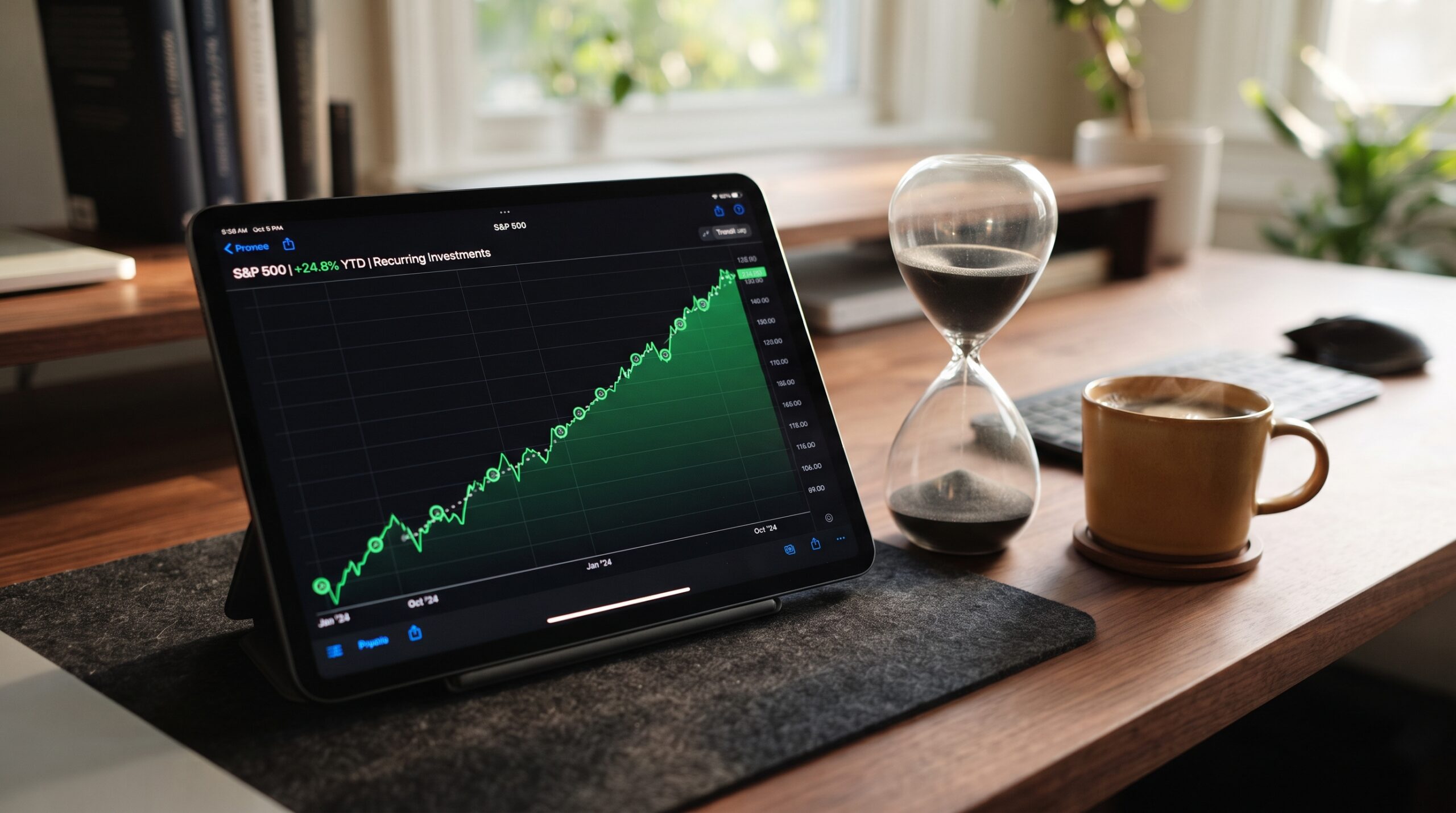
Sitting on a pile of uninvested cash during volatile market swings triggers intense hesitation. You watch stock prices drop, promising yourself you will buy at the absolute bottom, only to see the market suddenly surge before you can place an order. Fear of entering at a market peak causes paralytic hesitation, keeping your capital uninvested on the sidelines while inflation steadily erodes your long-term purchasing power.
Attempting to time entry and exit points in equity markets requires consistent forecasting precision that even seasoned institutional managers fail to achieve. Integrating dollar-cost averaging into your financial routine eliminates emotional guesswork, automating investment contributions to build consistent long-term wealth regardless of short-term headline noise.
What Is Dollar-Cost Averaging?
Dollar-cost averaging (DCA) is an execution strategy where you invest a fixed dollar amount into a target asset on a regular, automated schedule—such as $500 on the first day of every month—regardless of current share prices.
-
High Price Conditions: When asset prices are high, your fixed contribution automatically buys fewer total shares.
-
Low Price Conditions: When market prices drop during downturns, that same fixed allocation purchases a larger volume of discounted shares.
This structural dynamic systematically lowers your average cost per share over extended horizons, protecting your portfolio from the psychological temptation to buy high during euphoria or panic-sell during pullbacks.
The High Cost of Missing Best Market Days
The biggest hazard of waiting on the sidelines to time market dips is missing sudden, explosive recovery days. Market bounces frequently happen during broader bear trends, often taking place within days of sharp drawdowns.
Market Returns Excluding Peak Performance Days
Historical S&P 500 index tracking illustrates how missing just a handful of top-performing sessions significantly reduces long-term compounding growth:
-
Fully Invested Period: Captures baseline annualized compounding returns (~8% to 10%).
-
Missing Top 10 Days: Reduces long-term total return potential by nearly half over multi-decade horizons.
-
Missing Top 30 Days: Drops overall portfolio performance down toward baseline cash yields.
Comparing Investment Execution Strategies
| Strategy | Primary Execution Focus | Key Strengths | Major Drawbacks / Risks |
| Dollar-Cost Averaging (DCA) | Fixed periodic automated contributions | Removes emotional bias; automates discipline | May underperform lump-sum in steady bull markets |
| Lump-Sum Investing | Immediate single-sum deployment | Maximizes time-in-the-market exposure | Vulnerable to short-term timing panic if markets drop |
| Market Timing | Discretionary cash entries on dips | Offers theoretical maximum upside | High failure rate; cash drags down purchasing power |
How to Set Up an Automated DCA Strategy

Step 1: Automate Bank Transfers
Establish recurring payroll deductions or automatic bank transfers directly into your brokerage account on set paydays. Removing manual trade steps ensures consistent execution.
Step 2: Choose Broad-Market Index Assets
Pair DCA schedules with low-cost, broadly diversified index funds (such as total stock market or S&P 500 funds). Indexing ensures that temporary market pullbacks represent buying opportunities across whole economies rather than individual company risks.
FAQ
Is lump-sum investing better than DCA if I have a large windfall?
Historical data shows lump-sum investing outperforms DCA roughly two-thirds of the time because markets tend to trend upward over long periods. However, DCA provides vital psychological protection against immediate market drops right after deploying capital.
How often should I make DCA contributions?
Monthly or bi-weekly contributions aligned with your pay cycle work best. Frequency matters less than keeping the automated schedule consistent over time.
Does dollar-cost averaging prevent investment losses?
No. DCA does not guarantee a profit or shield your account from market drawdowns. It manages timing risk by spreading share purchases across different price levels over time.
Should I stop dollar-cost averaging during a severe bear market?
No. Market drawdowns are when DCA delivers its core benefit, allowing your fixed contribution to purchase more shares at lower valuations before eventual market recoveries.
Can I use DCA with individual stocks?
Yes, but DCA works best with broad-market index funds or ETFs. Individual stocks carry company-specific risks and may not always recover from severe structural price declines.