
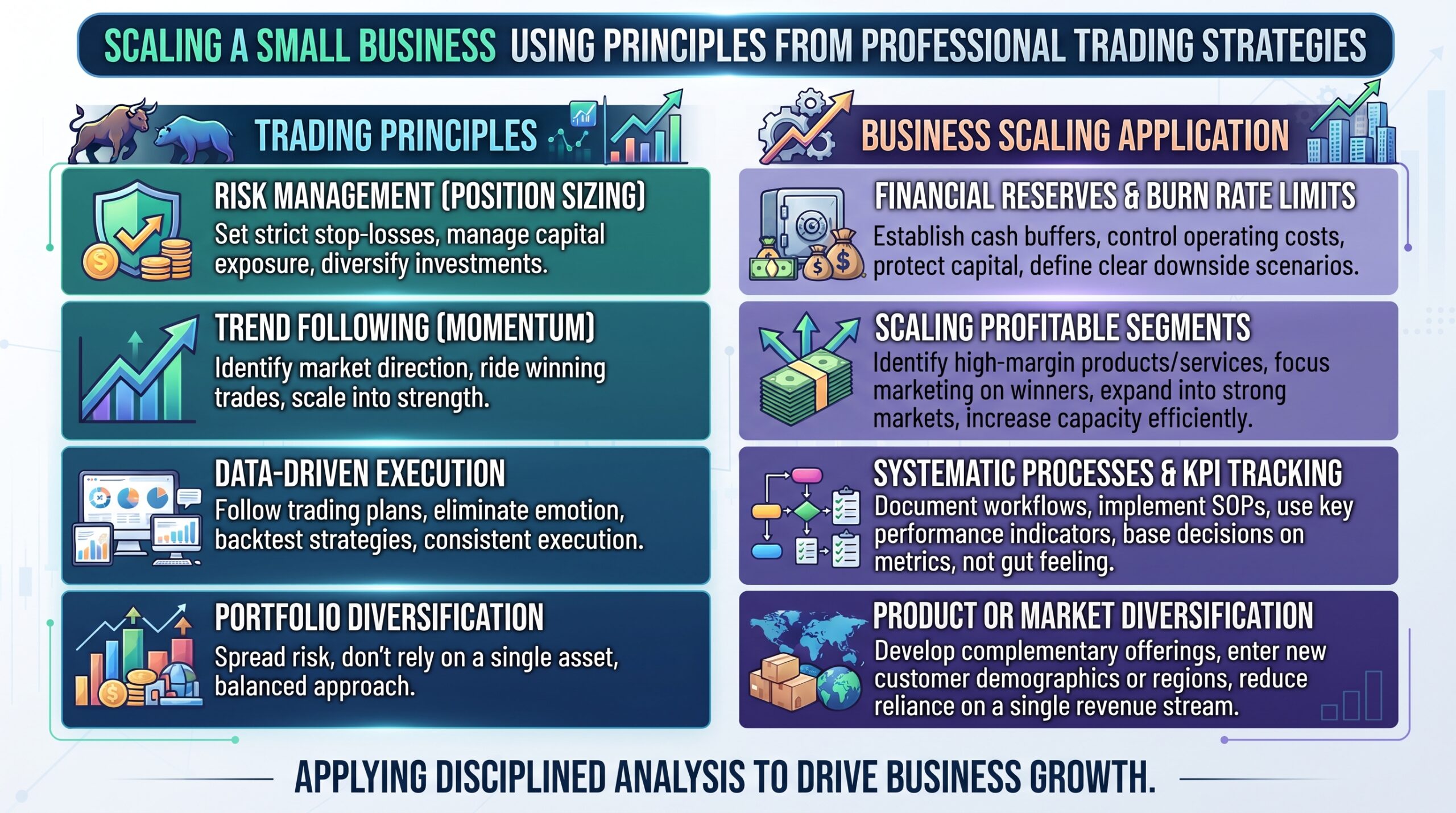
Small businesses often grow the way amateur traders trade—by feel. You double ad spend after one good week. You hire because a competitor hired. You launch a second location because the first one is busy on Saturdays. Then a quiet month arrives, cash tightens, and the “strategy” was never a strategy. It was a streak.
Professional traders who last do not rely on streaks. They rely on position sizing, written rules, measured risk, journals, and the discipline to do nothing when the setup is wrong. Those principles transfer surprisingly well to scaling a small business. You are not turning your company into a day-trading desk. You are borrowing a survival mindset: grow in units you can afford to be wrong about. This article is educational, not financial, legal, or investment advice.
Think in Risk Units, Not Vibes
Traders define how much of the account they will risk on a single idea. Owners can define how much cash, time, and reputation they will risk on a single growth bet. A new product line, a big inventory order, or a marketing campaign should have a maximum acceptable loss decided before launch. If the downside would break payroll, the unit is too large—regardless of how exciting the upside slide looks.
Scale in increments. Raise ad budgets in steps with clear kill metrics. Add headcount only when recurring revenue covers the role under conservative assumptions. Open a second site only after the first produces stable processes, not merely heroic owner hours. Professional trading is obsessed with staying in the game. Professional scaling should be, too.
Predefine Invalidation for Business Bets
A trader exits when the thesis breaks. A business bet needs the same clarity: which metrics, by which date, mean you stop or cut? Vanity revenue without margin, customer acquisition costs that never pay back, or operational error rates that climb with volume are invalidation signals. Write them down when optimism is high so fear or ego cannot rewrite them later.
Build a Playbook Before You Increase Size
Traders document setups: entry criteria, invalidation, size, and review notes. Businesses that scale cleanly document the repeatable engine: how a lead becomes a paid customer, how fulfillment works, how support resolves issues, how cash moves. If the engine only runs when you personally intervene, larger volume will amplify chaos. Size multiplies systems. It also multiplies the absence of systems.
Create a simple playbook for your core offer first. Standardize delivery steps, quality checks, and handoffs. Then increase marketing or sales input. Traders who add leverage before they have a tested edge often vaporize accounts. Owners who add demand before they have delivery control often vaporize reviews and cash.
Journal Like an Operator
Keep a short weekly log: what you tried, what it cost, what it returned, what you will change. This mirrors a trading journal. Over a quarter, patterns appear—channels that only work with discounts, seasons that strain inventory, services that consume support hours. Scaling without a journal is arguing with memory. Memory is biased toward the wins you want to repeat.
Separate “Core Book” From “Satellite Experiments”
Many durable traders run a core approach and limit experimental strategies to a small sleeve of capital. Businesses can mirror that structure. Protect the core offer that pays the bills. Cap experiments—new SKUs, new platforms, new customer segments—at a fixed percentage of cash and attention. When the experiment sleeve is spent, stop and review instead of quietly draining the core.
This separation prevents a common failure mode: funding novelty by neglecting the customers who already trust you. It also makes success measurable. An experiment either earns a promotion into the core or it ends. Traders call this allocation. Owners should call it focus.
Opportunity Cost Is a Position Limit
Every yes is a size decision. If you take every partnership and every custom request, you are running too many correlated positions. Professional desks reduce overlapping risk. Professional operators reduce overlapping projects that all depend on the same scarce founder time.
Use Drawdown Rules for Cash and Energy
Traders respect max daily loss limits. Businesses need max drawdown rules for cash runway and for founder bandwidth. Define a minimum cash floor. If projections show a campaign or hire pushing you through that floor without a near-term offset, the trade is too big. Define workload limits that protect quality. A growth push that breaks your error rate is a hidden liquidation.
Stress-test plans with ugly assumptions: slower collections, higher refunds, delayed suppliers. If the plan only works in a perfect month, it is not a scale plan—it is a hope script. Traders survive fat-tail days by sizing for them. Operators survive messy quarters the same way.
Avoid “Revenge Scaling”
After a bad month, amateurs increase size to win it back. After a disappointing launch, owners sometimes slash prices and overspend on ads to force a rebound. That is revenge trading in operational clothing. Return to the playbook, cut to the risk unit, and rebuild from measured steps. Emotional scale-ups create messy data and messier cash.
Measure Expectancy, Not Isolated Wins
A trader evaluates a strategy across many trades: average win, average loss, win rate, and cost of execution. A business should evaluate channels and offers the same way. One viral week proves little. Twenty weeks of contribution margin after ad spend, refunds, and support cost prove more. Build simple expectancy thinking into your reviews: does this channel pay after realistic friction?
Include hidden costs in the math—payment fees, returns, founder time, tooling. Traders who ignore commissions think they are profitable until the statement arrives. Owners who ignore labor and error costs think a product is a winner until the calendar says otherwise. Edge is what remains after friction.
Review on a Calendar
Hold a monthly or quarterly “desk review.” Read the journal, compare outcomes to hypotheses, retire dead experiments, and only then raise risk units on what worked. Calendar reviews beat continuous tinkering. Continuous tinkering is how both traders and owners rationalize noise as signal.
People, Process, and the Limits of the Metaphor
Employees are not trade tickets. Culture, law, and ethics constrain what you can “cut” when a bet fails. Use trading principles for capital allocation and decision hygiene, not as a license to treat people as disposable positions. Clear roles, fair incentives, and training are part of risk management because human error is operational leverage in the wrong direction.
Compliance and customer trust are also non-negotiable risk controls. A tactic that grows revenue while damaging reputation is a short trade with a long bill. Professionals price tail risk. Your brand is a tail-risk asset.
A Compact Scale Rule Card
Risk each growth bet at a predefined maximum loss. Document the core playbook before raising demand. Cap experiments. Enforce cash and quality floors. Review expectancy on a calendar. No revenge scaling. No leverage you cannot service under ugly assumptions. That card will not look flashy on social media. It will look familiar to anyone who has watched a quiet, durable firm outlast louder competitors.
FAQ
How can trading principles help a small business scale?
They encourage predefined risk limits, written processes, measured experiments, and reviews based on data rather than emotion.
What is a “risk unit” in business?
The maximum cash, time, or operational disruption you are willing to lose on a single growth initiative if it fails.
Should I always grow as fast as possible?
No. Speed without process control multiplies errors, refunds, and cash stress.
How often should I review growth experiments?
Monthly checkpoints and deeper quarterly reviews work well for many small teams.
Is this approach only for online businesses?
No. Inventory, services, and local businesses all benefit from sizing bets and documenting repeatable delivery.
Is this financial advice?
No. It is general education. Business and trading both involve risk of loss. Seek professional advice for your situation.
Scale Like Someone Who Must Still Be Here Next Year
Scaling a small business with principles from professional trading strategies means treating growth as a series of risk-defined positions, not as a personality test. You size bets, write invalidation, protect the core book, journal outcomes, and raise exposure only when the playbook holds under load. The market—whether customers or charts—punishes confusion at larger size.
Pick one upcoming growth decision and assign it a maximum loss, a success metric, and a stop condition before you spend. That single habit moves you from hopeful scaling toward professional scaling. Stay in the game long enough for the right bets to compound.