
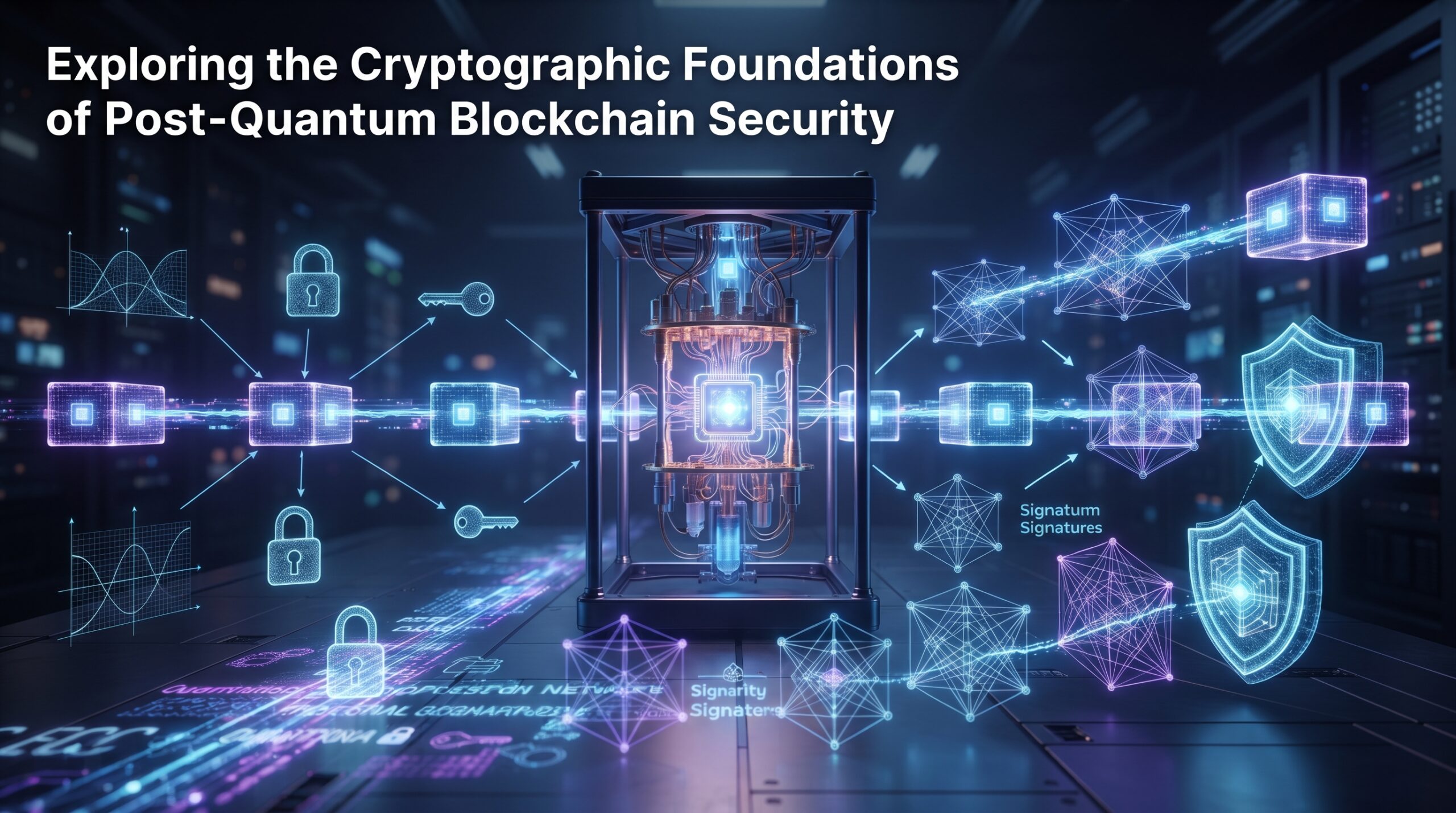
Quantum computing changes the conversation.
A sufficiently powerful quantum computer would not simply be a faster version of the machines we use today. It would use fundamentally different computational principles, allowing certain mathematical problems to be attacked much more efficiently than classical computers can manage. For blockchains, that creates an uncomfortable question: what happens when the cryptographic assumptions protecting digital assets stop being strong enough?
That question is the foundation of post-quantum blockchain security.
The threat is not necessarily an immediate crisis. Large-scale, fault-tolerant quantum computers capable of breaking widely deployed public-key cryptography do not currently exist. But blockchain networks have unusually long security horizons. Coins can remain dormant for years, addresses can be reused, historical transactions remain publicly visible, and migrating a decentralized protocol can take considerable time.
That means waiting until a powerful quantum computer actually arrives could be a dangerous strategy.
The smarter approach is preparation.
What Is Post-Quantum Blockchain Security?
Post-quantum blockchain security refers to the collection of cryptographic techniques, protocol changes, key-management practices, and migration strategies designed to keep blockchain networks secure in a world where sufficiently capable quantum computers exist.
The central objective is straightforward: replace or supplement cryptographic mechanisms that could become vulnerable to quantum attacks with algorithms believed to resist both classical and quantum adversaries.
This does not mean that every component of a blockchain suddenly becomes obsolete. Blockchains use cryptography for several different purposes, and each component has a different exposure to quantum computing. Digital signatures are generally viewed as one of the most significant areas of concern because quantum algorithms can threaten the public-key assumptions behind systems such as elliptic-curve cryptography.
Hash functions present a different situation.
Quantum algorithms can provide speedups against certain hash-search problems, but the impact is substantially different from the threat posed by Shor’s algorithm to many public-key systems. A blockchain therefore cannot be made “quantum safe” simply by changing one cryptographic primitive. Developers need to examine the entire security architecture.
Why Blockchains Have a Unique Quantum Problem
A traditional application can sometimes replace a cryptographic library during a routine software update. A public blockchain has a much harder problem.
Millions of users may control funds through independently generated keys. Wallet software may exist across multiple operating systems and hardware devices. Exchanges, custodians, smart contracts, bridges, explorers, validators, and decentralized applications can all depend on particular cryptographic assumptions.
Then there is the ledger itself.
A blockchain does not forget old transactions.
Even if a network eventually migrates to quantum-resistant signatures, previously exposed public keys and old cryptographic constructions can remain relevant to attackers. This makes migration planning just as important as selecting a new algorithm.
For blockchain developers, the practical question is therefore not simply, “Which post-quantum algorithm should we use?”
It is:
“How can we migrate an already operating economic network without breaking ownership, compatibility, performance, or decentralization?”
That is a much harder engineering problem.
How Quantum Computing Threatens Blockchain Cryptography
To understand post-quantum blockchain security, you first need to understand what quantum computers actually threaten.
Many blockchain networks rely on public-key cryptography to prove ownership. A wallet generates a private key and derives a corresponding public key or address. Transactions are then authorized with a digital signature that can be verified by the network.
Under classical computing assumptions, recovering a private key from a properly generated public key is computationally infeasible for widely used cryptographic systems.
Quantum computing introduces a major complication.
Shor’s Algorithm and Public-Key Cryptography
Shor’s algorithm is one of the most frequently discussed quantum algorithms in blockchain security because it can theoretically solve integer factorization and discrete logarithm problems efficiently on a sufficiently powerful fault-tolerant quantum computer.
Those mathematical problems underpin important families of classical public-key cryptography.
For blockchain networks using elliptic-curve digital signatures, the concern is particularly serious. If an attacker obtains a public key and has access to a sufficiently capable quantum computer, the attacker could theoretically derive the corresponding private key far more efficiently than with classical brute force.
That would undermine the fundamental ownership model.
The attacker would not need to guess a user’s password. The attack would target the mathematical relationship between public and private keys.
This is why quantum-resistant digital signatures are receiving so much attention.
The “Harvest Now, Attack Later” Problem
Quantum threats also create a time dimension.
An adversary could potentially collect publicly available blockchain data today and wait for future quantum capabilities to mature. This concept is often described as “harvest now, decrypt later,” although blockchain signatures are somewhat different from encrypted communications.
For blockchains, a more precise concern is that attackers can harvest public keys, transaction information, and other cryptographic material now and potentially exploit vulnerable constructions later.
Consider a wallet that has remained untouched for several years.
Its owner may assume that inactivity provides safety. But if the relevant public-key information is already exposed and a future quantum attacker can derive the corresponding private key, the age of the funds does not automatically protect them.
That creates a compelling argument for beginning migration before quantum computers become an operational threat.
The Cryptographic Building Blocks of a Quantum-Resistant Blockchain
Post-quantum cryptography is not a single algorithm. It is a broad research field containing several families of mathematical constructions.
Different approaches offer different combinations of security assumptions, signature sizes, verification performance, implementation complexity, and maturity.
For blockchain applications, these tradeoffs matter enormously.
A signature that is excellent for a conventional internet protocol may be inconvenient when millions of blockchain transactions need to be stored permanently.
Lattice-Based Cryptography
Lattice-based cryptography is one of the most prominent approaches to post-quantum security.
Its security is based on difficult mathematical problems involving lattices and related structures. Several lattice-based algorithms have become central to modern post-quantum standardization efforts.
Two names that frequently appear in discussions are Kyber and Dilithium.
However, there is an important distinction.
Kyber, standardized by NIST under the name ML-KEM, is designed for key encapsulation rather than ordinary blockchain transaction signatures. Dilithium, standardized as ML-DSA, is a digital signature scheme and is therefore more directly relevant to transaction authorization.
That distinction matters because articles about quantum-resistant blockchain security sometimes incorrectly describe all post-quantum algorithms as interchangeable.
They are not.
A blockchain wallet needs a mechanism for signing transactions. A communication protocol may need a mechanism for establishing shared secrets. The security requirements are related, but the cryptographic jobs are different.
Hash-Based Signatures
Hash-based signatures offer another important path.
Schemes such as SPHINCS+, standardized by NIST as SLH-DSA, rely heavily on hash functions rather than the algebraic structures used by traditional public-key cryptography.
Their appeal is conceptually attractive: cryptographic hash functions have a long history of analysis and can offer security properties that remain strong against quantum adversaries when appropriately parameterized.
The tradeoff is efficiency.
Hash-based signatures can involve substantial signature sizes and different performance characteristics compared with conventional elliptic-curve signatures.
That becomes significant on blockchains.
A blockchain stores transactions permanently, and every additional byte has consequences. Larger signatures can increase block sizes, bandwidth requirements, storage costs, synchronization time, and potentially the hardware requirements for running a full node.
Quantum resistance therefore has an economic cost.
Why Signature Size Matters
Imagine a blockchain where conventional signatures are relatively compact.
Now imagine replacing them with signatures that are many times larger.
The cryptographic security may improve, but the network has not magically become more efficient. Every block could carry more data. Nodes may need additional storage. Bandwidth requirements could rise. Fees may change because users compete for limited block space.
This is one reason post-quantum blockchain engineering cannot be reduced to choosing the strongest-looking algorithm.
The right question is about the complete system.
Developers need to evaluate signature size, verification cost, key size, implementation complexity, hardware requirements, wallet compatibility, transaction throughput, and long-term cryptographic confidence.
A theoretically excellent algorithm can still be a poor blockchain engineering choice if its operational costs are unacceptable.
Which Blockchain Networks Are Exploring Quantum Resistance?
Interest in quantum-resistant blockchain technology is not purely theoretical.
Different projects have explored post-quantum cryptography, quantum-resistant signatures, or broader migration strategies.
The Quantum Resistant Ledger, commonly known as QRL, is one of the most visible projects built around hash-based signatures and quantum-resistant blockchain design.
Algorand has also explored quantum-resistant cryptographic technology, including research involving Falcon signatures and mechanisms intended to support future quantum-resistance requirements.
Ethereum researchers have discussed post-quantum cryptography as part of the network’s longer-term roadmap and security research.
These examples demonstrate an important point: there is no universal blockchain migration template.
A network designed from the beginning around quantum-resistant signatures has considerably more freedom than an established blockchain with billions of dollars in assets, millions of wallets, and years of historical compatibility requirements.
The Difference Between Research and Production
Readers should also be careful when interpreting announcements about quantum-resistant blockchain technology.
“Researching PQC” does not necessarily mean that a blockchain has already migrated its entire transaction system to post-quantum cryptography.
There is a major difference between:
- researching a cryptographic primitive,
- running a testnet experiment,
- supporting optional quantum-resistant accounts,
- deploying a hybrid signature system,
- and requiring quantum-resistant signatures across the network.
These stages should not be treated as equivalent.
When evaluating a blockchain’s quantum readiness, look for technical specifications, implementation details, formal proposals, audited code, migration mechanisms, and actual deployment status rather than relying solely on marketing language.
The Hardest Part: Migrating Existing Blockchains
Selecting a quantum-resistant signature scheme may actually be easier than migrating an established blockchain.
Imagine that a network has been operating for ten years.
There are dormant addresses. Lost keys. Hardware wallets. Exchange infrastructure. Smart contracts. Bridges. Custodial systems. Old software versions. Users who rarely update their wallets.
Now introduce a new signature system.
Who must upgrade?
How are old addresses handled?
What happens to users who never migrate?
Can quantum-vulnerable funds be frozen?
Should users receive a deadline?
Could a malicious actor exploit the migration period?
These questions become governance problems as much as cryptographic ones.
Backward Compatibility Can Become a Security Problem
Backward compatibility is normally considered a virtue in software.
In cryptography, however, keeping vulnerable legacy mechanisms alive indefinitely can create an attack surface.
A blockchain might introduce quantum-resistant addresses while continuing to accept older signature types. That improves flexibility, but it also means vulnerable assets remain exposed.
A future migration could therefore involve several phases.
First, the network could introduce quantum-resistant transaction formats. Next, wallets and exchanges could support them. Later, users could be encouraged or required to migrate assets. Eventually, governance could decide whether legacy cryptography remains acceptable.
The exact sequence would depend heavily on the blockchain’s architecture.
There is no universally correct timetable.
Hybrid Cryptography
One practical strategy is hybrid cryptography.
Instead of immediately abandoning an established classical signature system, a protocol can require both a classical signature and a post-quantum signature.
The idea is simple.
An attacker would need to compromise both security mechanisms to forge a valid transaction, assuming the protocol combines them correctly.
Hybrid approaches can reduce dependence on a single cryptographic assumption and provide a transition path while post-quantum algorithms gain more implementation experience.
But hybrids are not free.
They increase transaction size and implementation complexity. Wallets need to manage additional keys. Verification becomes more complicated. Smart contracts and infrastructure may require changes.
Security engineering is often about managing tradeoffs rather than discovering a perfect solution.
Practical Quantum-Security Checklist for Blockchain Users
You do not need to be a cryptographer to make better decisions about quantum risk.
If you hold digital assets for the long term, start by understanding how your wallet derives and exposes public keys.
Avoid assuming that an address format alone proves quantum resistance. A familiar-looking address can conceal very different underlying cryptographic mechanisms.
Also monitor the development roadmap of the blockchain you use.
Look for concrete information about post-quantum migration, supported signature schemes, wallet compatibility, and governance proposals.
For Wallet Developers
Wallet developers should design for algorithm agility.
A wallet architecture that permanently assumes one signature scheme will be much harder to migrate than one that separates key management from cryptographic implementation.
Developers should consider:
- modular cryptographic libraries,
- support for multiple signature schemes,
- secure key rotation,
- transaction-versioning mechanisms,
- migration-friendly address formats,
- hardware-wallet compatibility,
- clear user warnings,
- and recovery procedures.
The goal is not necessarily to deploy every post-quantum algorithm today.
The goal is to avoid creating a system that cannot evolve tomorrow.
For Blockchain Developers
Protocol designers should model quantum migration as a lifecycle rather than a single upgrade.
Threat modeling should consider exposed public keys, dormant assets, transaction replay, smart-contract dependencies, validator infrastructure, bridges, custodians, and exchange integrations.
Performance testing should include realistic blockchain workloads.
Do not benchmark an algorithm only on a laptop and declare it ready for production. Measure how it behaves when millions of signatures are generated, propagated, verified, stored, and eventually reconstructed by nodes.
That is where the real engineering difficulty appears.
Why Post-Quantum Security Could Reshape Blockchain Architecture
Quantum resistance may eventually influence more than signatures.
It could affect wallet design, address schemes, smart-contract systems, transaction formats, hardware security modules, custody architecture, and even economic incentives.
There is another subtle issue: cryptographic agility.
A blockchain that successfully migrates once will eventually face another cryptographic question. Algorithms that look secure today can become weaker tomorrow because of mathematical advances, implementation vulnerabilities, or unexpected attacks.
The long-term objective should therefore not be “find one quantum-proof algorithm and stop.”
It should be “build a blockchain capable of changing cryptography safely.”
That distinction could become one of the most important lessons of the post-quantum era.
Quantum Resistance Is Not the Same as Absolute Security
The phrase “quantum-resistant” can sound stronger than it really is.
No serious cryptographic system should be described as permanently unbreakable.
Post-quantum cryptographic algorithms are designed around mathematical assumptions believed to resist known classical and quantum attacks. Researchers continue to analyze those assumptions, implementations can contain vulnerabilities, and parameter choices matter.
There is also the human element.
A perfectly designed signature scheme does not prevent a user from losing a seed phrase, installing malicious wallet software, approving a fraudulent transaction, or exposing private keys through poor operational security.
Quantum resistance addresses a specific class of technological threats.
It does not eliminate every security problem.
The Economics of Post-Quantum Blockchain Security

Security upgrades always have costs.
Post-quantum blockchain security could increase transaction sizes, computational requirements, storage consumption, and development complexity.
Those costs eventually become economic questions.
Who pays for larger transactions?
Do users pay higher fees?
Do blockchains increase capacity?
Does hardware become more expensive?
Could higher resource requirements push smaller operators out of the validator or full-node ecosystem?
These questions are not secondary.
Decentralization depends partly on how many independent participants can realistically operate the network.
If a quantum-resistant upgrade dramatically increases infrastructure requirements, developers may have to balance cryptographic security against accessibility.
The Fee-Market Question
Suppose post-quantum signatures substantially increase transaction size.
If blockspace remains scarce, users may compete for the additional space through higher fees.
That creates an interesting incentive structure.
A security improvement could indirectly make certain transactions more expensive.
Protocol designers therefore need to examine not only cryptographic performance but also fee economics.
Compression, signature aggregation, batching, efficient transaction formats, and specialized verification techniques may become increasingly valuable.
The strongest post-quantum blockchain may ultimately be the one that combines quantum-resistant cryptography with efficient data engineering.
FAQ
1. What is post-quantum blockchain security?
Post-quantum blockchain security is the effort to protect blockchain networks against future quantum computers capable of breaking or weakening cryptographic mechanisms currently used for digital signatures and related security functions. It involves quantum-resistant algorithms, migration strategies, wallet upgrades, protocol changes, and cryptographic agility.
2. Can quantum computers break Bitcoin?
A sufficiently powerful fault-tolerant quantum computer could theoretically threaten the elliptic-curve cryptography used by Bitcoin’s digital signatures through Shor’s algorithm. That does not mean Bitcoin is currently broken by quantum computers. The practical challenge is preparing a secure migration path before quantum computing reaches the necessary capability.
3. Are blockchains using post-quantum cryptography today?
Some blockchain projects have implemented or researched quantum-resistant cryptographic approaches, while others are investigating migration strategies. The degree of deployment varies considerably, so “quantum-resistant blockchain” should not be treated as a single standardized category.
4. Is Ethereum quantum resistant?
Ethereum is not simply “quantum resistant” or “not quantum resistant.” Its cryptographic architecture contains mechanisms that researchers consider vulnerable to sufficiently powerful quantum attacks, and Ethereum researchers have actively investigated post-quantum approaches. The important issue is how and when the ecosystem migrates its cryptographic infrastructure.
5. What is the best post-quantum algorithm for blockchain?
There is no universal winner.
ML-DSA, SLH-DSA, and other post-quantum signature technologies each have different security assumptions and performance characteristics. A blockchain needs to evaluate signature size, verification speed, key management, implementation maturity, ecosystem compatibility, and long-term security requirements before selecting an approach.
Conclusion: The Quantum Threat Is a Migration Problem
The most useful way to think about post-quantum blockchain security is not as a science-fiction scenario waiting for a dramatic breakthrough.
It is an engineering deadline without a precisely known date.
Quantum computers capable of threatening widely deployed public-key cryptography are not simply sitting behind the next software update. But blockchain infrastructure is slow to change, valuable assets can remain dormant for decades, and cryptographic migrations require coordination across wallets, exchanges, developers, validators, custodians, applications, and users.
That is why preparation matters.
The next generation of blockchain security will likely depend not only on stronger cryptographic algorithms but also on flexible architectures capable of replacing those algorithms when necessary.
For blockchain developers, the practical takeaway is clear: begin designing for cryptographic agility, test post-quantum alternatives realistically, understand migration risks, and treat quantum resistance as a lifecycle problem rather than a checkbox.
For users, the lesson is simpler.
Do not wait for headlines about a quantum computer breaking a major blockchain before asking whether your assets can migrate safely.
The strongest defense is rarely the last-minute patch.
It is having a migration path before the emergency begins.