
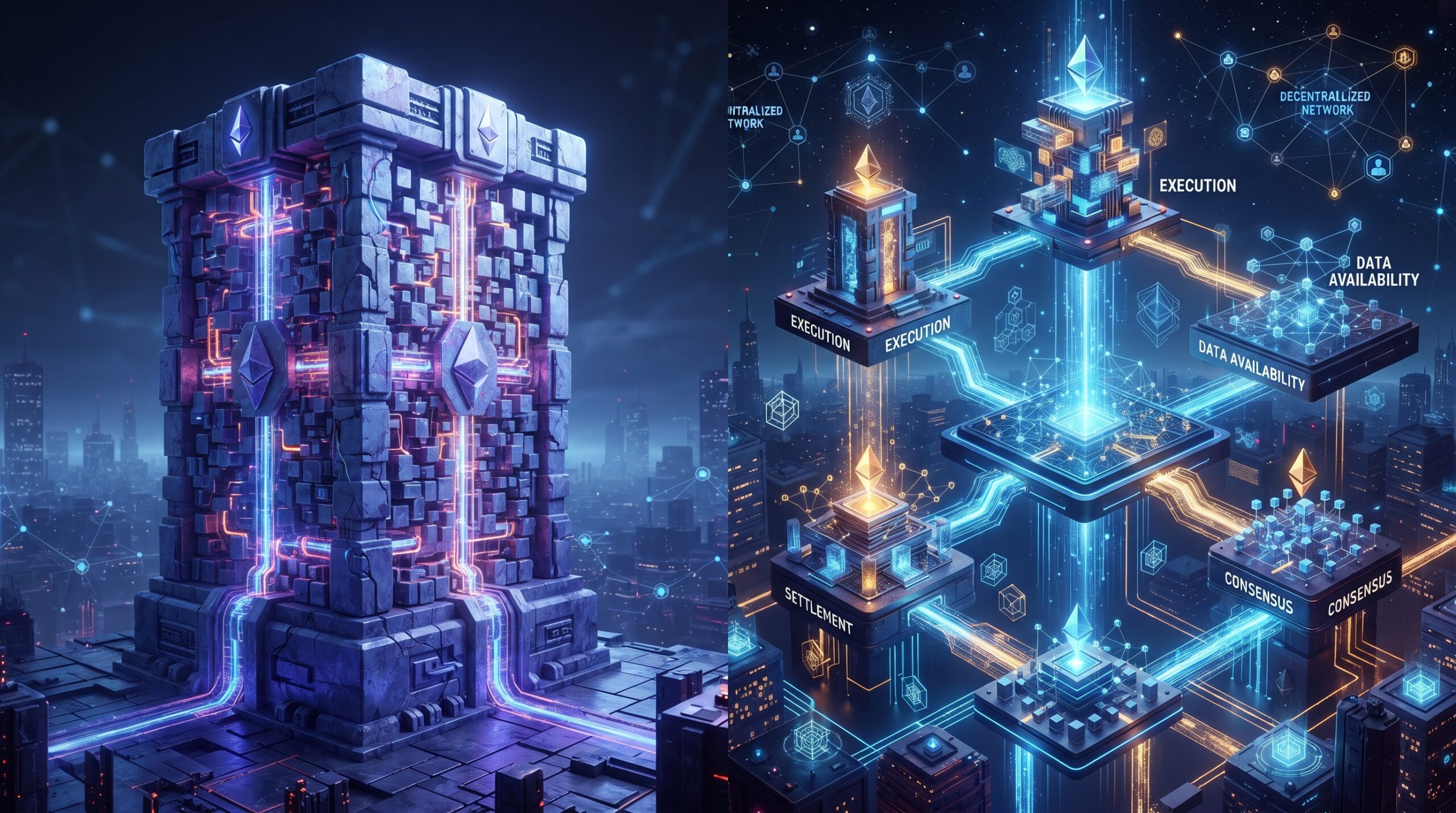
For years, the blockchain industry followed a deceptively simple formula: build one powerful network and make that network responsible for almost everything.
Transactions. Execution. Consensus. Data storage. Security. Settlement.
It was an elegant idea, but elegance becomes a problem when millions of users arrive at the same time.
A blockchain that handles every job inside one tightly integrated system can be extremely robust, but it also faces a difficult trade-off. Increasing transaction capacity may increase hardware requirements. Increasing block sizes can make it harder for ordinary users to operate nodes. Lowering fees can create new economic pressures. And optimizing one component can sometimes make another component more complicated.
That is where modular blockchains enter the picture.
Instead of forcing a single blockchain to perform every function, modular architecture separates blockchain responsibilities into specialized layers. One layer can focus on execution, another on data availability, another on settlement, and another on consensus or security.
Think of it like replacing one enormous factory with a network of specialized factories.
The result is potentially more flexible, scalable infrastructure.
Ethereum is already moving heavily in this direction through its rollup-centric scaling strategy and data-availability upgrades. Ethereum’s roadmap describes rollups as a central part of its scaling approach, while upgrades such as Proto-Danksharding introduced temporary blob storage designed to make rollup data cheaper.
But this does not mean monolithic blockchains are suddenly obsolete.
Far from it.
The real competition is more interesting: Which blockchain architecture can deliver the best combination of scalability, security, decentralization, cost and developer flexibility?
That question could shape the next phase of crypto infrastructure.
What Is a Modular Blockchain?
A modular blockchain separates different responsibilities that were traditionally handled by one network.
To understand why this matters, consider the major functions a blockchain needs to perform.
A blockchain must determine the order of transactions. It must make transaction data available. It must execute transactions and calculate state changes. It may also need to provide settlement and dispute-resolution mechanisms.
A traditional monolithic blockchain generally performs these functions within the same base system.
A modular blockchain takes a different approach.
Instead of asking one network to be excellent at everything, developers can combine specialized components.
One layer might provide data availability. Another might execute smart contracts. A settlement layer might verify proofs or resolve disputes. Consensus may be handled separately.
Celestia describes the distinction in similar terms, explaining that traditional monolithic blockchains combine major blockchain functions while modular systems separate them into specialized layers.
This separation creates an important advantage.
Specialization.
Imagine asking one employee to write software, manage databases, design graphics, answer customer support tickets and run financial reporting.
Technically possible.
Efficient?
Probably not.
The same principle applies to blockchain infrastructure.
When each layer has a clearly defined responsibility, developers can optimize that layer without redesigning the entire network.
Monolithic vs. Modular Blockchain Architecture
The easiest way to understand the difference is to compare the two architectures directly.
Monolithic Blockchains
A monolithic blockchain attempts to handle most major blockchain functions within one integrated protocol.
The advantage is simplicity from an architectural perspective.
Everything is connected.
The same network provides execution, consensus and data availability.
This can make security assumptions easier to understand because users are interacting with one primary environment.
Bitcoin is an obvious example of a highly integrated blockchain design, while Ethereum historically followed a more monolithic architecture before increasingly shifting toward rollup-centric and modular scaling.
The problem appears when demand increases dramatically.
If every transaction must be processed by the base chain, the blockchain faces a fundamental capacity ceiling.
You can increase block capacity.
You can improve node performance.
You can optimize execution.
But every improvement comes with trade-offs.
Larger blocks, for example, can place greater demands on network bandwidth, storage and hardware.
That can make participation more difficult for smaller operators.
And decentralization is not something you want to accidentally sacrifice while chasing throughput.
Modular Blockchains
Modular architecture approaches the problem differently.
Rather than making the base chain execute every transaction itself, execution can move to specialized networks such as rollups.
The base layer can concentrate on security and data availability.
Ethereum is a major example of this direction.
Rollups execute transactions outside Ethereum Mainnet and then publish information needed to verify their results back to Ethereum. Ethereum’s current scaling documentation explicitly describes Layer 2 rollups as a central component of its scaling strategy.
This creates a powerful relationship.
The base layer does not necessarily need to execute every transaction.
Instead, it can provide the infrastructure that allows other systems to scale while maintaining a connection to Ethereum’s security model.
That is a very different way of thinking about blockchain scalability.
Why Monolithic Blockchains Are Under Pressure
The argument against monolithic architecture is not that it is inherently bad.
The real issue is that blockchain demand is changing.
Early cryptocurrency networks primarily needed to transfer value.
The modern blockchain ecosystem wants much more.
Users expect decentralized exchanges, lending markets, stablecoins, gaming applications, social networks, tokenized assets, prediction markets, payments and increasingly sophisticated financial products.
Every application creates additional transaction demand.
And when thousands of applications compete for the same block space, congestion becomes expensive.
This produces one of the oldest problems in blockchain:
block space is scarce.
Scarcity is useful for a network’s security economics, but expensive block space is a terrible user experience when you’re trying to build applications for millions of people.
Modular architecture attempts to address that bottleneck by creating additional execution environments rather than forcing every application to compete for the same execution capacity.
The Rise of Ethereum Rollups
Ethereum’s development provides perhaps the clearest example of the modular shift.
Instead of attempting to make Ethereum Mainnet execute every transaction directly, the ecosystem increasingly uses Layer 2 rollups.
Rollups bundle transactions and process them away from the Ethereum base layer before posting relevant data and state information back to Ethereum.
This can significantly reduce the amount of work that users need to pay the base chain to perform.
The Dencun upgrade in March 2024 introduced EIP-4844, commonly known as Proto-Danksharding, which added temporary data blobs designed specifically to make rollup data cheaper.
That was more than a simple fee reduction.
It represented a philosophical change.
Ethereum was effectively building infrastructure for other execution environments.
The base chain increasingly becomes the settlement and data-availability foundation.
The rollups become the execution environments.
That is modular blockchain architecture in practice.
Data Availability Is the Hidden Battle
When people talk about blockchain scalability, they often focus on transactions per second.
That number is easy to understand.
But serious blockchain infrastructure engineers worry about something deeper:
Can the network prove that transaction data is actually available?
Data availability means participants have confidence that the data required to verify blockchain activity has been published and can be accessed when needed.
Ethereum’s documentation describes data availability as essential because validators and other participants need sufficient information to independently verify blockchain activity.
This creates a difficult scaling problem.
Suppose blocks become enormous.
A validator may theoretically be able to process them, but if every ordinary participant must download huge quantities of data constantly, operating a node becomes increasingly demanding.
Eventually, the blockchain risks becoming something that only large infrastructure providers can comfortably operate.
That creates a decentralization problem.
And that is exactly why modular blockchain research increasingly focuses on data availability sampling, or DAS.
What Is Data Availability Sampling?
Data availability sampling allows participants to verify that large quantities of blockchain data are available without downloading everything.
Instead of downloading the entire block, a light node samples portions of the data.
Cryptographic techniques allow the node to gain confidence that the complete dataset is available.
Celestia uses data availability sampling as a core part of its modular architecture, allowing light nodes to verify availability without downloading entire blocks.
The concept is powerful because it changes the scaling equation.
Instead of saying:
Every participant must process everything.
The system can move toward:
Participants can verify that the required data exists without processing every byte themselves.
That difference could become one of the most important innovations in blockchain infrastructure.
Ethereum’s Modular Transformation
Ethereum deserves special attention because it demonstrates how a blockchain can gradually transition toward modular architecture without abandoning its existing security model.
The network’s roadmap has increasingly focused on scaling through Layer 2 systems and improving the availability of data for those systems.
Proto-Danksharding introduced blobs that provide cheaper temporary storage for rollup data. Those blobs are not permanent blockchain storage; Ethereum documentation currently describes their availability period as roughly 18 days.
That distinction matters.
Ethereum does not need to permanently store every byte of rollup transaction data on every node if the system can provide the appropriate cryptographic assurances and external historical-data solutions.
The goal is to make the data available long enough for verification while avoiding unnecessary permanent storage burdens.
Ethereum has continued this direction through subsequent scaling work. Its roadmap reports that Fusaka, deployed in December 2025, introduced PeerDAS and increased blob parameters, further expanding data availability capacity for rollups.
This illustrates something important.
Modularization is not necessarily a single upgrade.
It is a long-term architectural transition.
Celestia and the Data Availability Market
Celestia represents a more explicit version of modular blockchain design.
Rather than building a general-purpose blockchain that tries to execute every application, Celestia focuses heavily on consensus and data availability.
Its documentation describes Celestia as a modular data availability network where execution and settlement can exist above the base layer.
That specialization creates an interesting business model for blockchain infrastructure.
Instead of competing directly with every smart-contract platform, a modular network can become infrastructure for many other networks.
Think about cloud computing.
Amazon Web Services does not need to build every application itself.
It provides infrastructure on which thousands of companies build different products.
Modular blockchains can follow a similar philosophy.
The infrastructure becomes reusable.
One data availability layer can potentially support multiple execution environments.
One settlement layer can interact with multiple rollups.
One security system can protect multiple applications.
This is where modular architecture becomes particularly compelling.
Modular Blockchains Could Create a Blockchain Internet
The most interesting possibility is not simply that modular blockchains become faster.
It is that they change how blockchain networks are assembled.
Imagine a developer launching a new blockchain application.
Instead of building everything from scratch, the developer could select:
- An execution environment
- A data availability layer
- A settlement layer
- A consensus mechanism
- A proving system
- A sequencing architecture
- A bridge or interoperability framework
The blockchain becomes a stack.
Much like modern software development.
Developers already build applications using databases, cloud services, APIs, authentication systems and specialized infrastructure.
Blockchain development may move in the same direction.
The result could be a world where launching a customized blockchain becomes much easier.
That does not mean every project will need its own chain.
It means the economic and technical cost of creating specialized execution environments could continue falling.
The Biggest Advantage: Specialization
Specialization is arguably the strongest argument for modular architecture.
A monolithic blockchain must balance multiple objectives simultaneously.
It needs strong security.
It needs high throughput.
It needs affordable fees.
It needs manageable node requirements.
It needs reliable consensus.
It needs developer flexibility.
Those objectives can conflict.
A modular system can separate them.
For example, an execution layer could optimize specifically for gaming.
Another could focus on decentralized finance.
Another might prioritize privacy.
Another might specialize in payments.
The underlying data availability layer does not necessarily need to understand the application logic.
It only needs to perform its own job correctly.
That separation could encourage experimentation.
Developers can innovate at one layer without redesigning the entire blockchain stack.
But Modular Blockchains Have Serious Problems
The modular thesis sounds attractive.
There is a catch.
Complexity.
Once you split a blockchain into multiple layers, you introduce more moving parts.
And every additional component creates another potential failure point.
A monolithic blockchain might have one primary security model.
A modular stack could involve:
- The base chain
- An execution layer
- A bridge
- A sequencer
- A proving system
- A data availability provider
- Interoperability infrastructure
- Wallet infrastructure
Users may never see this complexity directly.
But developers certainly will.
A bug in one component can potentially affect the entire application.
The bridge problem is particularly serious.
Historically, bridges have represented major attack surfaces throughout the crypto industry.
Therefore, modularity should never be interpreted as automatically meaning greater security.
It means greater flexibility.
Security depends on how the components interact.
The Sequencer Problem
Rollups create another important question:
Who orders transactions?
Many Layer 2 systems rely on sequencers.
A sequencer collects transactions, determines their order and submits batches to the underlying settlement or data-availability layer.
This can dramatically improve performance.
But it also creates centralization concerns.
If one entity controls the sequencer, users may have to trust that operator to behave correctly.
The operator could potentially censor transactions, delay transactions or influence ordering.
The industry is therefore exploring decentralized sequencing and other approaches designed to reduce these risks.
This is a perfect example of why modular blockchain development is not simply a race toward more transactions per second.
The real challenge is improving scalability without rebuilding the same trust problems that blockchains were designed to eliminate.
Interoperability Becomes Critical
Imagine a future where thousands of specialized blockchains exist.
Sounds exciting.
It could also become chaotic.
If each chain operates independently, users may face fragmented liquidity, incompatible assets and complicated application experiences.
You could end up with a blockchain ecosystem that resembles dozens of isolated islands.
That is why interoperability matters.
A modular future requires reliable communication between execution environments.
Assets need to move.
Messages need to travel.
Applications need to interact.
Users should ideally not care which chain processes their transaction.
The best infrastructure may eventually make the underlying modular stack invisible.
That is the dream.
You interact with an application.
The application automatically chooses the appropriate execution environment.
The infrastructure handles settlement, data availability and interoperability behind the scenes.
What This Means for Crypto Developers
For developers, the modular blockchain race creates an enormous opportunity.
You no longer necessarily need to build an entire Layer 1 network.
Instead, you can focus on the specific problem your application solves.
A gaming developer might prioritize extremely fast execution.
A financial application might require predictable fees and strong settlement guarantees.
A privacy-focused application could choose a specialized execution environment.
The architecture can be selected according to the application’s requirements.
This changes the first question developers should ask.
Instead of:
“Which blockchain should I deploy on?”
The better question may become:
“Which blockchain stack is best suited to the application I am building?”
That is a much more sophisticated decision.
What This Means for Crypto Investors
Investors should also look beyond simple transaction-count narratives.
A blockchain infrastructure project can have value because it provides a critical service to many applications.
That does not automatically mean its token will increase in price.
Those are separate questions.
When evaluating a modular blockchain project, look at the underlying economics.
Ask:
Who actually uses the network?
Developer announcements are easy to produce.
Real usage is harder.
Look for meaningful activity rather than purely promotional partnerships.
What problem does the protocol solve?
A network providing a critical infrastructure service may have stronger long-term positioning than a project simply marketing itself as “faster.”
Is demand organic?
A network can show impressive transaction numbers while providing little economic value.
Understand where the activity originates.
What are the security assumptions?
Ask what happens if a component fails.
Ask who controls upgrades.
Ask whether the system depends on centralized operators.
Where does revenue come from?
If a protocol generates fees, determine what creates those fees.
Real economic demand matters more than superficial usage statistics.
Why Developers May Prefer Modular Architecture
There is another advantage that receives less attention.
Customization.
A monolithic blockchain forces developers to accept the limitations and design decisions of the base chain.
A modular architecture gives developers more control.
They can choose execution environments.
They can experiment with virtual machines.
They can customize fee structures.
They can choose different data availability providers.
They can build application-specific chains.
This creates a much larger design space.
And innovation usually accelerates when developers have more design options.
Are Monolithic Blockchains Really Losing?
The title of this article makes a strong claim.
But the reality is more nuanced.
Monolithic blockchains are not disappearing.
Networks such as Solana demonstrate that there is still significant interest in highly integrated architectures that attempt to maximize performance within a single system.
The monolithic approach has genuine advantages.
Everything is integrated.
Composability can be excellent.
Users may not need to understand multiple layers.
Developers can deploy applications into one shared environment.
Liquidity can remain concentrated.
These are powerful benefits.
The modular approach solves different problems.
It improves flexibility and specialization, but introduces interoperability and coordination challenges.
So the future may not be:
Monolithic vs. modular.
It may be:
Monolithic where integration creates the most value, modular where specialization creates the most value.
That is a much more realistic prediction.
The Hybrid Future of Blockchain Infrastructure
The likely future could combine both architectures.
Some blockchains will remain tightly integrated because their applications benefit from shared execution and liquidity.
Other ecosystems will become highly modular.
And some networks may combine both approaches.
Ethereum is already an example of this hybrid evolution.
The base layer maintains core security and settlement functions while Layer 2 networks handle specialized execution.
At the same time, Ethereum continues increasing its own execution and data capacity.
The result is not a pure modular or pure monolithic architecture.
It is a layered ecosystem.
That may ultimately be the winning model.
How to Evaluate a Modular Blockchain Project
If you are researching a modular blockchain for development, investment research or general crypto education, use a structured checklist.
1. Identify the Layer
First, determine what the project actually does.
Is it an execution layer?
A data availability network?
A settlement layer?
A sequencer?
An interoperability protocol?
A proving system?
If you cannot explain the project’s role in one sentence, research it further before making assumptions.
2. Study Its Security Model
Do not stop at marketing language.
Find out exactly what secures the network.
Does it inherit security from another chain?
Does it have its own validator set?
Does it depend on trusted operators?
What happens if a component becomes unavailable?
These questions are much more valuable than simply asking how many transactions per second the network claims.
3. Examine Developer Adoption
Look for actual applications.
Look for active developers.
Look for integrations that users can interact with.
A strong ecosystem is usually more meaningful than a long list of announced partnerships.
4. Understand the Economics
Ask who pays.
Ask who earns.
Ask why users need the network.
Ask whether the token has a genuine role in the protocol.
A technically impressive system still needs sustainable economics.
5. Watch Interoperability
The more modular the ecosystem becomes, the more important interoperability will become.
A technically excellent isolated network may struggle if it cannot communicate efficiently with the broader crypto ecosystem.
The Bigger Picture: Blockchain Is Becoming Infrastructure
The crypto industry spent its first major era trying to create decentralized digital money.
Then came smart contracts.
Then decentralized finance.
Then NFTs, Layer 2 networks, appchains and specialized execution environments.
Now the industry is increasingly focused on infrastructure.
That shift matters.
The next generation of blockchain competition may not be determined by which chain has the loudest marketing.
It may be determined by which infrastructure can quietly support millions of applications.
Users do not care which database handles a web application.
They care whether the application works.
Blockchain may eventually reach the same point.
The technical architecture becomes invisible.
The user simply sees an application that is fast, affordable and reliable.
What Happens Next?

The modular blockchain race is still developing.
Ethereum is continuing to expand data availability capacity and improve its rollup-centric architecture. Its 2026 roadmap emphasizes continued work on both execution capacity and blob/data availability scaling.
Celestia continues developing infrastructure around modular data availability and data availability sampling.
Meanwhile, alternative ecosystems continue experimenting with highly integrated architectures.
This competition is healthy.
Blockchain technology does not need one universal architecture.
Different applications have different requirements.
A decentralized exchange may want shared liquidity.
A game may want extremely fast execution.
A financial application may prioritize settlement guarantees.
A data-heavy application may need cheap data availability.
A modular future makes those differences easier to accommodate.
FAQ
1. What is a modular blockchain?
A modular blockchain separates blockchain functions such as execution, consensus, settlement and data availability across specialized layers. Instead of one network doing everything, different components can focus on specific tasks.
2. What is the difference between modular and monolithic blockchains?
A monolithic blockchain performs most major blockchain functions within one integrated system. A modular blockchain separates those functions across specialized layers. Modular architecture can improve scalability and flexibility, while potentially introducing greater system complexity.
3. Is Ethereum a modular blockchain?
Ethereum is increasingly adopting a modular, rollup-centric architecture. Ethereum Mainnet provides core security and data availability while Layer 2 networks perform much of the execution. Its blob infrastructure was introduced specifically to make rollup data cheaper.
4. What is data availability?
Data availability refers to whether the transaction data needed to verify blockchain activity has been published and can be accessed by the appropriate network participants. It is particularly important for Layer 2 networks and modular blockchain systems.
5. Is modular blockchain technology better than monolithic blockchain technology?
Neither approach is universally better. Modular architecture offers specialization and flexibility, while monolithic systems can offer simpler integration and strong composability. The best architecture depends on the application’s requirements.
Final Thoughts
The blockchain industry is moving beyond the idea that one network must do everything.
That does not mean monolithic blockchains are dead.
It means developers now have another option.
Instead of building one enormous machine responsible for every task, they can assemble specialized infrastructure where each component does one job extremely well.
That could unlock a new generation of blockchain applications.
The most important competition may therefore not be between individual tokens or chains.
It may be between architectures.
Who can provide the best combination of scalability, decentralization, security, interoperability and cost?
The answer is still being written.
For developers, that means opportunity.
For investors, it means research.
And for users, it could eventually mean something much simpler: blockchain applications that finally feel less like blockchain applications.