Stepping into the professional digital asset arena can feel like navigating an intricate maze without a reliable map. Many retail participants and market commentators frequently misunderstand how massive corporate liquidity engines operate, assuming that blockchain adoption relies purely on volatile public exchange trading. This week, a monumental structural shift occurred on global financial networks, completely upending how elite financial institutions interact with tokenized fiat capital.
How to Start Trading Cryptocurrency Step by Step
Venturing into advanced digital asset custody or attempting to allocate massive financial capital across public networks without a rigorous, bank-grade compliance framework is a definitive path to immediate regulatory and operational failure. Before executing a single high-volume smart contract swap or trying to manage cross-border corporate liquidity, an uncompromising operational setup must be engineered from the ground up to guarantee total asset safety.
The professional configuration process begins at the foundational onboarding layer. First, you establish a fully verified corporate profile inside a regulated digital asset banking ecosystem or prepare an enterprise-grade custody interface to interact securely with decentralized settlement layers. Once your institutional account architecture is properly funded with base sovereign fiat, you can safely deploy automated hedging algorithms, utilize real-time minting tools, or clear large-scale transactions.
Corporate Fiat Reserves ──> Integrated G-SIB Portal ──> Compliant Tokenized Settlement ──> Instant On-Chain Liquidity
To survive high-velocity market environments, we strongly advise utilizing a multi-tiered capital segregation routing system. Always isolate your highly active transactional liquidity from your long-term foundational balance sheet reserves. This strict separation guarantees that even if a specific decentralized application faces an unexpected network exploit or temporary smart contract freeze, your core institutional runway remains perfectly insulated and secure.
Standard Chartered Opens USDC Stablecoin Access to Institutional Clients
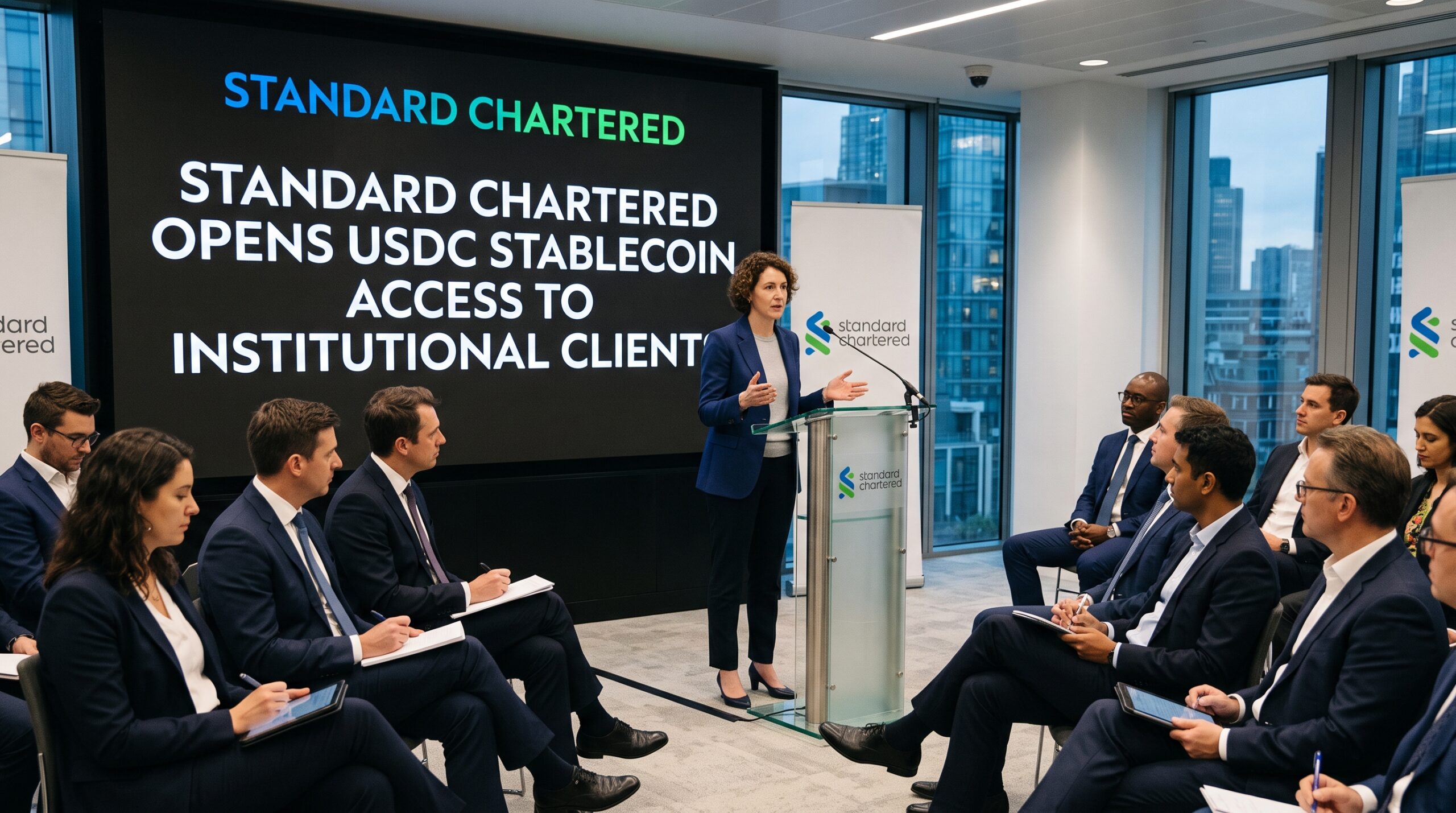
The structural walls dividing traditional banking systems and public decentralized infrastructure are officially crumbling under the weight of massive corporate demand. In an unprecedented industry milestone, banking titan Standard Chartered has formally opened automated tokenization pipelines, allowing its eligible corporate and investment banking clients to mint and redeem Circle’s USD Coin directly through its internal ecosystem. This deep integration is the first time a Global Systemically Important Bank (G-SIB) has completely embedded native stablecoin creation mechanics straight into its institutional dashboard, fundamentally altering how enterprise capital accesses public ledger rails.
By launching thisfull-stack capability first through its highly regulated Dubai International Financial Centre (DIFC) operations, the multi-national banking giant is completely eliminating the standard friction points of digital asset onboarding. Institutional allocators no longer need to navigate the operational hazards of opening separate, unhedged accounts with independent stablecoin issuers or third-party crypto-native brokers. Instead, corporate treasuries can now seamlessly convert massive fiat dollar holdings into liquid on-chain cash while remaining completely insulated within the elite compliance, risk management, and governance frameworks of an international banking conglomerate.
The Enterprise Catalyst: Moving Treasury Management Onto Public Rails
The corporate push to integrate stablecoin infrastructure directly into legacy banking rails is driven by an intense global competition to control next-generation financial settlement layers.
-
Zero-Friction Tokenization: Institutional clients can effortlessly convert cash balances into active digital assets within a single, integrated bank account experience.
-
On-Chain Settlement Velocity: Multi-national corporations are heavily utilizing this framework to bypass slow legacy correspondent banking networks, achieving near-instant cross-border treasury settlements.
-
The Global Systemic Shift: As an elite G-SIB, the bank’s deep entry into native stablecoin issuance signals a massive long-term validation of public blockchain liquidity by traditional financial regulators.
Analyzing the Macro Horizon: The $2 Trillion Stablecoin Thesis

This major banking integration represents the mere tip of the iceberg—a 2026 Wall Street price bombshell is suddenly hurtling toward Bitcoin and crypto as global asset managers aggressively price in the total tokenization of institutional finance. With major infrastructure banks completely validating public ledgers like Ethereum for multi-million dollar settlement operations, the velocity of capital migration into decentralized spaces is projected to compound exponentially.
Legacy Fiat Banking ──> Integrated Bank Minting Rails ──> Mass Enterprise Adoption ──> $2 Trillion Stablecoin Market Cap
Prominent industry analysts point out that this integrated distribution model will rapidly expand liquidity across the entire digital asset ecosystem. As corporate treasuries get comfortable holding billions of dollars in regulated, bank-managed stablecoins, their natural progression will be to deploy that capital into yield-bearing decentralized protocols and core digital assets. For independent market participants, this institutional foundation establishes an incredibly strong macro floor, paving the way toward a projected $2 trillion global stablecoin market cap before the conclusion of 2028.
FAQ
What makes a Global Systemically Important Bank (G-SIB) integration different from a standard crypto exchange?
G-SIBs are subject to the absolute highest tier of international regulatory scrutiny and capital reserve requirements, meaning their digital asset products provide unmatched institutional trust, compliance, and counterparty safety.
Why are corporate treasuries choosing USDC over traditional wire transfer systems?
Traditional international wire systems can take multiple business days to settle and incur heavy intermediary fees, whereas stablecoins on public blockchains settle completely in seconds, 24/7, with absolute cryptographic transparency.
Can retail traders utilize Standard Chartered’s new integrated stablecoin minting pipeline?
No, this specialized financial architecture is exclusively reserved for institutional corporate entities, large-scale asset managers, and qualified investment banking clients navigating the DIFC ecosystem.